
Argostoli: The Complete Travel Guide (2026)
Argostoli Travel Guide: Everything You Need to Know (2026)
Argostoli has served as the capital of Kefalonia since 1757, rebuilt almost entirely after the catastrophic 1953 earthquake that levelled 85% of the island’s structures. Home to 10,982 residents, this compact Ionian town sits at sea level on a sheltered lagoon, giving it a distinctly different character from the cliff-top villages many visitors expect from a Greek island capital.
Three Things Not to Miss in Argostoli
- Drapano Bridge — A 690-metre causeway built in 1813 by the British, still the only road link across the lagoon to the Lixouri peninsula.
- Korgialenios History & Folklore Museum — Pre-earthquake artefacts and period interiors surviving 1953 — a rare window into Kefalonia’s lost architectural heritage.
- Katavothres Sea Mills — Seawater visibly disappears underground here, resurfacing 15 km away at Melissani Cave — one of Europe’s strangest hydrological phenomena.
Scroll down for our complete travel guide with tips on getting there, where to stay, costs and more.
How to Reach Argostoli
How do I get to Argostoli?
Fly directly into **Kefalonia International Airport (EFL)**, then take a taxi or bus the **9 km** into town. In my experience, the most practical approach from northern Europe or Athens is a direct charter or scheduled flight — **Aegean Airlines** and **Sky Express** operate Athens–EFL connections year-round, often under **€80** one-way if booked 6–8 weeks out. From **Patra** on the Greek mainland, a **KTEL bus plus ferry** via **Killini port** takes roughly 4 hours total and costs around **€25**. The honest caveat: off-season frequency drops sharply, so winter travellers may face a connection through Athens with an awkward layover.
Which airport is closest to Argostoli?
**Kefalonia International Airport (EFL)** is the closest, sitting just **9 km** south of Argostoli’s town centre — a **15-minute taxi ride** costing roughly **€15–€18**. In my experience, there is no airport bus on most days, so budget that taxi fare into your arrival plan. What surprised me is how small the terminal is: bag collection takes under 10 minutes, which is genuinely refreshing. The honest warning: during **July and August**, taxi queues at arrivals stretch to 30+ minutes because the single rank is undersized for peak charter traffic — pre-book a taxi through your accommodation.
How long does the journey to Argostoli take from Athens?
The fastest option is a **50-minute Aegean Airlines flight** from **Athens International (ATH)** to **EFL**, plus the **15-minute taxi** into town — door-to-door under 2 hours if connections align. My tip: the afternoon flight out of Athens often arrives in golden light, which makes the lagoon approach spectacular. The slower but scenic overland-plus-ferry route from **Athens KTEL Kifissou terminal** via **Patra** and the **Killini–Poros ferry** takes roughly **6 hours total**. The trade-off: the ferry crossing itself is only 90 minutes and very pleasant, but the bus schedules are infrequent and coordinating them wastes half a day.
Do I need a car in Argostoli itself?
For the town itself, no — Argostoli is walkable end-to-end in **20 minutes**. The **Lithostroto pedestrian street** and the waterfront promenade cover the main sights on foot. In my experience, the problem starts the moment you want to reach **Myrtos Beach** (30 km north) or **Skala** (25 km south-east) — a rental car becomes essential. Budget **€40–€65 per day** for a compact car from agencies on **Rokou Vergoti street** near the port. The honest caveat: Kefalonian roads are steep, winding, and occasionally single-lane — **do not underestimate them** if you’re not a confident driver. Scooters are cheaper at around **€25/day** but dangerous on mountain passes.
Argostoli Public Transport Explained
What are the best areas to stay in Argostoli?
Stay within a 5-minute walk of the **Vallianou Central Square** — this puts you equidistant between the waterfront, restaurants, and the bus station. The **harbour-facing streets** along **Ioannis Metaxa Avenue** offer sea views and a breeze that matters in August heat. My tip: avoid the blocks immediately behind the main taxi rank, which gets noisy from **5 a.m.** onward when ferry workers and market traders arrive. For families, the quieter residential streets toward **Korydallos hill** are calmer but require a 10-minute uphill walk back from dinner. There is no explicit ‘bad’ neighbourhood — at 10,982 residents, the town is genuinely small and safe throughout.
What does accommodation cost per night in Argostoli?
A solid mid-range hotel in Argostoli runs **€80–€130 per night** in shoulder season and spikes to **€150–€220 in August**. Budget options like guesthouses near **Plateia Vallianou** start around **€50**. In my experience, **Ionian Plaza Hotel** and **Mirabel Hotel** offer the best balance of location and price in the **€90–€120** bracket. Self-catering apartments — widely available through direct booking — cut costs noticeably: a studio with a kitchenette runs **€60–€90** in June or October. The caveat most guides skip: Argostoli’s accommodation stock is smaller than you’d expect for a capital; properties genuinely sell out in peak weeks, not just appear to.
How far in advance should I book accommodation in Argostoli during high season?
Book **at least 3–4 months ahead** for any July or August stay — I’ve seen the entire town’s decent stock disappear by April for peak-week arrivals. The **third week of August** coincides with the Greek national holiday exodus and is the tightest window of all. For June and the first half of July, **6–8 weeks** is usually sufficient. October — one of the verified best travel months for Argostoli — only requires **2–3 weeks’ notice** and rates drop **20–35%** compared to August peaks. My tip: book direct with smaller guesthouses; they often hold back rooms from OTA platforms and offer better cancellation flexibility.
Are there special or unique accommodation types in Argostoli?
The most distinctive option is a **restored Venetian-influenced stone mansion**, several of which operate as boutique guesthouses in the streets above **Lithostroto**. Because the 1953 earthquake destroyed most historic fabric, genuinely pre-earthquake buildings are rare and carry a premium — expect **€140–€180** per night but real architectural character. What surprised me: some **agriturismos** on the lagoon edge just outside town offer rooms above working olive groves for around **€70**, combining rural Kefalonian atmosphere with a **10-minute walk** into the centre. The honest trade-off: Argostoli lacks the clifftop infinity-pool villa aesthetic of **Fiscardo** to the north — if that’s your priority, you’ll need to look elsewhere on the island.
Neighbourhoods of Argostoli
What are the must-see sights in Argostoli?
Three sights earn every minute spent on them. The **Katavothres sea mills** (2 km north of town) are where seawater visibly drains underground — geologically extraordinary and completely free. The **Korgialenios History and Folklore Museum** on **Ilia Zervou Street** charges around **€4** entry and contains pre-earthquake interiors that survived because they were already in storage — a genuinely moving experience. The **Drapano Bridge**, a 690-metre British-built causeway from 1813, is best walked at sunrise when the lagoon is glassy and **loggerhead sea turtles (Caretta caretta)** surface to feed — the lagoon is a protected nesting area. The **Archaeological Museum** on **Rokou Vergoti** rounds out a full cultural morning for around **€4**.
What can I experience for free in Argostoli?
Quite a lot, frankly. The **waterfront promenade** running the full length of the harbour is free and best at dawn when **Caretta caretta turtles** feed near the fish market — no tour required, just arrive by **7 a.m.** The **Drapano Bridge** walk is free and one of the most atmospheric 20-minute strolls on the island. **Vallianou Square** on a summer evening costs nothing and showcases Kefalonian social life at its most authentic. The **Katavothres geological site** has no entry fee. What surprised me: the **municipal market building** near the port is free to browse and full of local olive oil, honey, and Robola wine producers selling direct — treat it as a free tasting room.
Which day trips from Argostoli are most worthwhile?
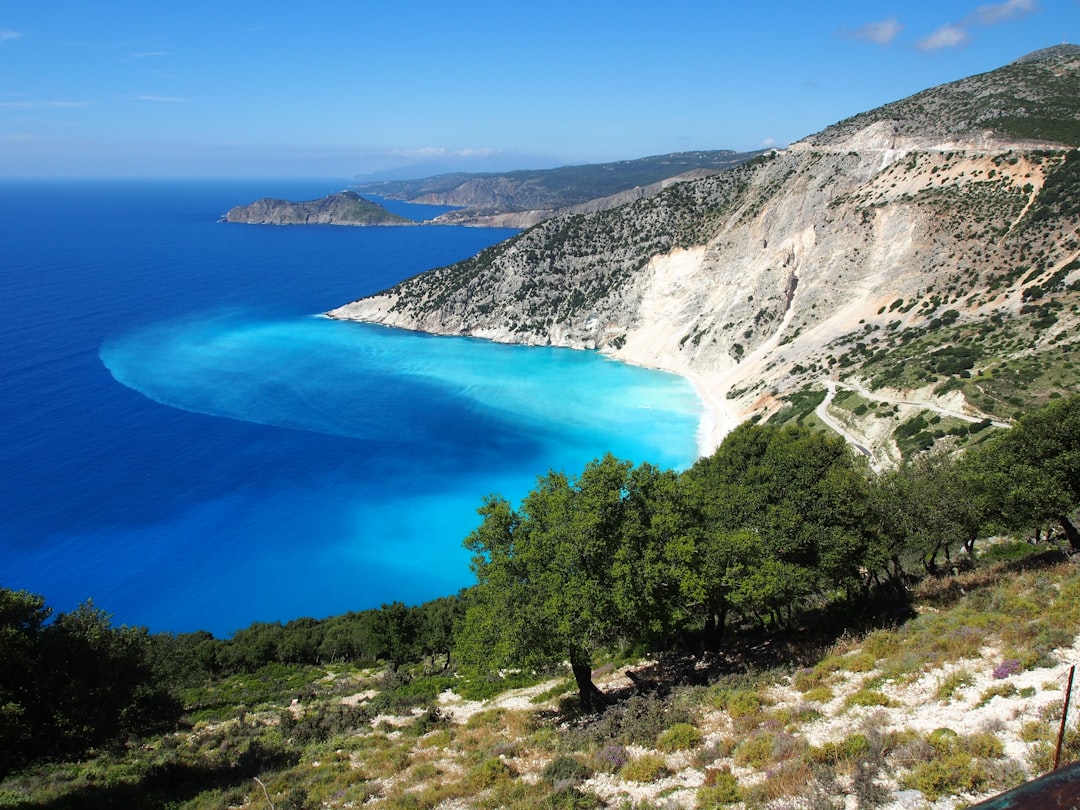
**Melissani Cave** (30 km north-east, roughly **€7** entry) is the single best day trip — the underground lake lit by a collapsed ceiling in spring/early summer is genuinely extraordinary, though peak-season boat queues can stretch **45 minutes**. **Myrtos Beach** (30 km north) consistently ranks among Greece’s top 3 beaches and is worth the winding drive. **Assos village** (35 km north) with its Venetian castle peninsula is the most photogenic settlement on the island. For something slower, the **Lixouri peninsula** is only a **30-minute ferry** from Argostoli port (roughly **€2.50**) and almost completely free of mass tourism — **Xi Beach** there has unique red sand unlike anything else on Kefalonia.
What are the local specialities to eat in Argostoli?
Order **Kefalonian meat pie (kreatopita)** at least once — it’s lamb and rice encased in hand-rolled pastry, sold from bakeries on **Lithostroto** for around **€3–€4 a slice** and nowhere near as widely found beyond the island. **Robola wine**, a dry white from the mountain vineyards above **Omala valley**, is the island’s DOC grape and pairs brilliantly with the local seafood — a bottle in a taverna runs **€12–€18**. **Aliada** (salt cod with garlic sauce) appears on most traditional menus for **€8–€10**. My tip: the fish market near the port opens by **6 a.m.** — buy directly and ask your apartment kitchen to cook it, or watch which tavernas are sourcing there each morning — that’s where to eat.
What to See in Argostoli
What makes Argostoli unique compared to other Greek island capitals?
Argostoli is one of the only Greek island capitals almost entirely rebuilt from a single catastrophic event — the **1953 earthquake** — which makes its neoclassical street grid feel simultaneously historic in style and modern in age. It also sits on a rare enclosed lagoon rather than an open harbour, giving it a different light and a turtle population that lives **within town limits** year-round. What surprised me: it functions as a genuinely working administrative capital with a **courthouse, university faculty, and daily market** that most Greek island towns its size lack — meaning it stays alive outside tourist season in a way that **Fiscardo** or **Skala** completely do not. It’s a town for travellers who want Greece without the performance.
How many days in Argostoli are worthwhile?
Use Argostoli as a **2-night base** minimum — one day exploring the town itself and the northern lagoon area, one day for a car-based circuit hitting **Myrtos, Assos, and Melissani Cave**. If you plan to explore the south of the island (Skala, **Katelios**, the lighthouse at **Agios Theodoros**), add a third night. In my experience, 4 nights total makes Argostoli the most logical island hub — you can reach every corner of Kefalonia as a day trip without relocating your bags. The honest caveat: Argostoli’s town centre itself is exhausted after a single full day — it is not a destination that rewards a week of urban exploration the way **Athens** or **Heraklion** might.
When is the best time to visit Argostoli?
Based on verified climate analysis, **June, August, and October** are the optimal months. June is my personal favourite: crowds are thinner than August, the island is green, and temperatures sit around **26–28°C** without August’s oppressive heat. August is peak season — vibrant but expensive and busy. **October** is the underrated choice: sea temperature stays above **22°C** for swimming, accommodation drops **20–35%**, and the olive harvest begins — you can join picking sessions on farms outside town. The honest warning: **November through March** sees many restaurants and hotels close entirely, and the island can feel quietly melancholic — not unpleasant, but plan for limited services.
Are there local festivals in Argostoli worth attending?
The **Robola Wine Festival** held at **Omala valley** (12 km from Argostoli) in early August charges a nominal **€5–€8** entry which includes unlimited tastings — one of the best-value agricultural festivals in the Ionian. **Carnival (Apokries)** in February or March animates Vallianou Square with parades that feel authentically local rather than tourist-facing. The feast day of **Agios Gerasimos** on **August 16** draws pilgrims from across Greece to the monastery 10 km east of town — a striking spectacle involving processions and sick pilgrims seeking healing, which is culturally fascinating but requires respectful observation. My tip: the **August 15 Assumption of Mary** celebrations in **Markopoulo village** (30 km south-east) attract harmless snakes said to appear only on that date — genuinely worth the detour.
Argostoli Food Scene
How does the weather in Argostoli affect what activities are possible?
Argostoli sits at **sea level** on a west-facing lagoon, meaning summer afternoons bring a reliable northwesterly breeze — useful for cooling but strong enough to affect small boat excursions. **June through September** allows all beach and watersports activity without reservation. **October** permits swimming and hiking comfortably, and the light for photography is exceptional. **November through April** brings rainfall concentrated in short intense bursts rather than all-day grey — hiking trails through the **Ainos National Park** (1,628m peak) become muddy and sometimes impassable. What surprised me: the **Caretta caretta turtle watching** from the waterfront is actually better in spring (April–May) when females approach the lagoon before nesting, outside the tourist rush entirely.
How crowded does Argostoli get in peak season?
The town itself handles crowds reasonably well — **Vallianou Square** gets lively but not gridlocked even in August. The pressure point is traffic: the single road north toward **Myrtos Beach** becomes a slow convoy between **10 a.m. and noon** in July–August, adding **30–40 minutes** to what should be a 35-minute drive. The **Lixouri ferry** queues can stretch to **90 minutes** for cars on Saturday changeover days. My honest assessment: Argostoli is significantly less overwhelmed than **Fiscardo** or **Skala**, partly because it’s a working town without a pretty harbour full of superyachts. Arrive at Myrtos before **9 a.m.** in peak weeks — the car park fills completely by 10:30 and latecomers are turned back.
How safe is Argostoli for travellers?
Argostoli is extremely safe — petty crime is genuinely rare in a town of **10,982** where residents know each other. In my experience, leaving a jacket on a taverna chair while you visit the bathroom carries essentially zero risk. The main physical hazards are environmental: **unlit road edges** outside town drop away sharply on mountain routes at night, and the **Ionian Sea** develops sudden afternoon swells on exposed western beaches that catch swimmers off guard. The **2014 earthquake swarm** (magnitude 5.1–6.0) reminded visitors that Kefalonia sits on an active seismic zone — know your hotel’s evacuation procedure as a basic precaution. No targeted crime against tourists has been a notable issue here.
Is English widely spoken in Argostoli?
English fluency in Argostoli is high by Greek island standards — **90%+ of tourism-facing businesses** (restaurants, hotels, car rental agencies) operate comfortably in English. What surprised me: even the **municipal market vendors** and ferry ticket sellers typically manage basic English transactions without difficulty. Greek is always appreciated — even a fumbled **’Efcharisto’** (thank you) and **’Parakalo’** (please) visibly warms interactions. The honest caveat: at the **KTEL bus station**, timetable announcements are Greek-only and staff English varies — download the **KTEL Kefalonias** schedule PDF in advance and screenshot it. Away from town, in mountain villages like **Dilinata** or **Zola**, Greek is essentially the only language in play.
Local Know-How for Argostoli
What is the daily budget for visiting Argostoli?
A realistic mid-range daily budget in Argostoli runs **€100–€140 per person** including accommodation, meals, and one paid attraction. Broken down: **€80–€110** for a hotel room (split two ways: **€40–€55**), **€12–€16** for a sit-down lunch with wine, **€18–€25** for dinner at a proper taverna, **€4–€8** for museum entry or cave visits, and **€15–€25** for car rental split between two people. Budget travellers using guesthouses and eating gyros (**€3.50**) and market produce can manage **€55–€70/day**. The hidden cost most guides omit: **petrol** on Kefalonia is expensive relative to the mainland — island surcharges push prices **15–20% higher**, and the winding roads burn more fuel than flat routes suggest.
How does public transport work in and around Argostoli?
The **KTEL Kefalonias bus station** sits on the southern waterfront and connects Argostoli to **Sami** (45 min, **€3.50**), **Skala** (1 hr, **€4**), **Poros** (1.5 hrs, **€5**), and **Fiskardo** (1.5 hrs, **€6**) — but frequencies are punishing: most routes run **2–3 times daily** at best, with nothing in the evening. Within Argostoli itself, walking covers everything. The **Lixouri ferry** from the town port runs roughly **every 30 minutes** in summer (6 a.m.–11 p.m.) for **€2** per passenger, **€8** per car — the most useful public transport link on the island. My honest assessment: for a proper island circuit, KTEL alone is inadequate — you will miss **Myrtos Beach** and **Assos** entirely without a rental car.
Which apps do you recommend for visiting Argostoli?
**Maps.me** with offline Kefalonia maps downloaded before arrival is non-negotiable — mobile signal drops entirely on **Ainos mountain** and several northern coastal roads. **Google Maps** works for navigation but misses rural tracks that Maps.me includes. **e-KTEL** (the KTEL national app) gives live bus times, though Kefalonian timetables update irregularly — cross-reference with the paper schedule at the station. **Windy.com** matters more than you’d think: afternoon sea conditions at **Petani Beach** and **Antisamos** change quickly, and Windy’s hourly coastal forecast is accurate enough to plan boat trips around. For restaurants, **i-Food** (the Greek equivalent of Deliveroo) shows which local spots are open on any given day — more useful off-season than any review site.
Argostoli at a Glance
| Population | 10,982 |
|---|---|
| Currency | EUR (€) |
| Official language | Greek |
| Time zone | UTC+02:00 |
Source: Wikidata, retrieved September 2026.
Greece › Argostoli
More Destinations in Greece
Essential Resources for Planning Your Trip to Argostoli
- Wikipedia: Argostoli — history, geography & background
- Wikivoyage: Argostoli — community travel guide & practical tips
- Argostoli, Ionian Islands, Greece, Europe — expert itineraries & travel inspiration
- THE 15 BEST Things to Do in Argostolion (2026) — hotels, restaurants & traveller reviews
- Planning a trip to Kefalonia — how to get around
- Numbeo: Cost of Living in Argostoli — current prices & cost comparison
- Timeanddate: Argostoli Weather & Climate — forecasts & climate statistics
More Perspectives on Argostoli
- A complete first time visitor’s guide to Kefalonia
- Travel Guide to Argostoli Region (Central)
- What are recommendations for things to do and see in …
Argostoli Travel Videos
Watch these videos for a visual preview before your trip:
- Argostoli Cruise Port Guide | Top Things to Do In Kefalonia Greece (4K)
- Kefalonia, Argostoli, Greece. Port and Town Guide.
- Explore Argostoli! Best Walkable Attractions in Kefalonia’s Capital
Argostoli Travel Discussions on Reddit
Real traveller experiences and community advice:
- Kefalonia (Greece) planning: the island is bigger than you …
- Kefalonia trip: Lixouri vs. Argostoli for accommodations
- Thinking about Kefalonia? Here’s what I wish I knew before …
Data Sources
This page was compiled using data from Wikipedia, Wikidata, Open-Meteo (climate), Numbeo (cost of living) and REST Countries. Information is updated regularly.