
Kalabaka: The Complete Travel Guide (2026)
Last reviewed: September 2026 · key facts checked against Wikidata
Kalabaka Travel Guide: Everything You Need to Know (2026)
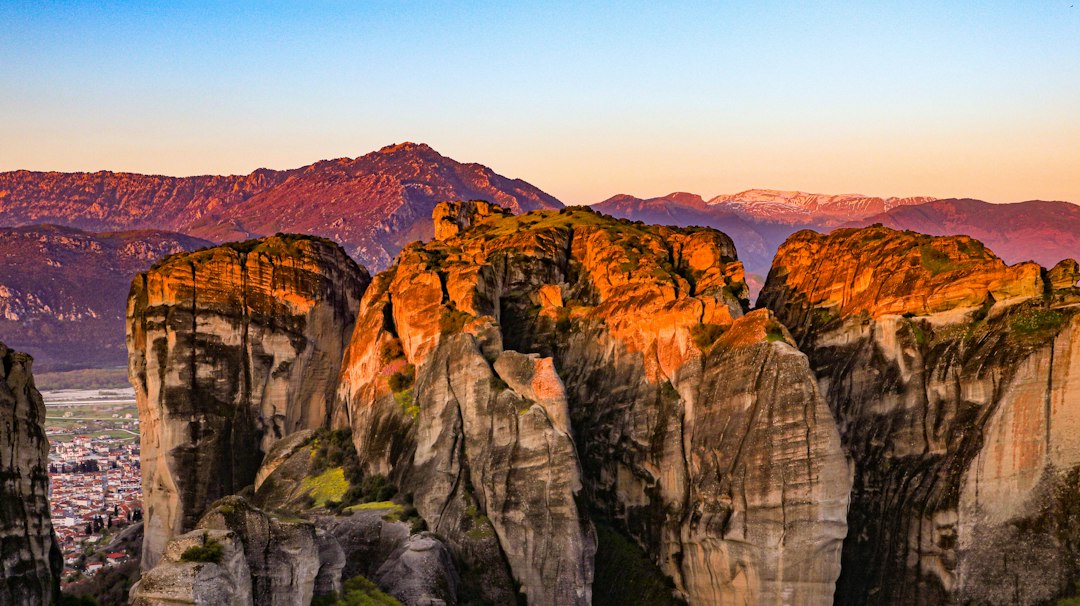
Kalabaka is a Greek town of 8,372 residents sitting at 237 metres above sea level at the foot of the extraordinary Meteora rock pillars, one of UNESCO’s most dramatic World Heritage Sites. Founded as an Ottoman-era settlement, it serves today as the primary gateway for the monasteries perched on sandstone columns rising up to 400 metres overhead. The town itself is compact enough to walk end-to-end in 20 minutes, yet it anchors one of the most jaw-dropping landscapes on the European continent.
Three Things Not to Miss in Kalabaka
- Meteora Monasteries at Sunrise — Six active monasteries crown vertical rock towers; the golden morning light at 6 AM makes the crowds vanish and the views transcend.
- Byzantine Cathedral of the Assumption — Kalabaka’s 11th-century cathedral preserves rare early Christian frescoes inside a town most visitors walk straight past.
- Meteora Viewpoint Trail (Psaropetra Loop) — A 7-kilometre loop trail delivers eye-level monastery panoramas that no tour bus road can replicate.
Scroll down for our complete travel guide with tips on getting there, where to stay, costs and more.
Arriving in Kalabaka: Airport & Transfers
How do I get to Kalabaka?
The fastest overland route is the direct train from Athens. In my experience, the InterCity train from Athens Larissa Station takes roughly 4 hours 30 minutes and deposits you directly at Kalabaka station — the northwestern terminal of the OSE network. Buses from Athens (KTEL Trikala line via Trikala hub) take around 5 hours and cost approximately €18–€22. By car from Athens via the E65 motorway, expect 3 hours 30 minutes covering about 320 km. The honest caveat: Greek trains run late more often than schedules suggest — build a 45-minute buffer into any connection you plan onward from Kalabaka.
Which airport is closest to Kalabaka?
Thessaloniki Airport (SKG) is the most practical international entry point, sitting roughly 200 km northeast of Kalabaka — about a 2-hour 30-minute drive. My tip: Volos Airport (VOL) is geographically closer at around 130 km, but it handles very limited seasonal flights. Athens International Eleftherios Venizelos (ATH) at 320 km offers far more flight connections, making it the better choice for intercontinental travellers despite the longer ground transfer. What surprised me: no direct airport shuttle serves Kalabaka, so you must rent a car or take a regional KTEL bus via Trikala from whichever airport you land at.
How long does the journey to Kalabaka take from Athens?
By train the journey is 4 hours 30 minutes to 5 hours depending on the service. I recommend the morning InterCity departure from Athens Larissa Station, which typically arrives in Kalabaka by early afternoon — leaving you a full afternoon for the Meteora viewpoints. By car via the E65 toll motorway, the 320 km drive takes around 3 hours 30 minutes in normal traffic. The caveat most guides skip: the final 40 km on the Trikala–Kalabaka stretch is single-carriageway and can slow dramatically behind trucks, especially in summer.
Do I need a car in Kalabaka?
For the town itself, no — Kalabaka’s centre is entirely walkable in under 20 minutes. For the Meteora monasteries, a car or scooter transforms the experience dramatically. In my experience, the local taxi rank on Trikalon Street charges around €10–€15 per monastery loop — fine for a single day but expensive across multiple visits. Renting a scooter from local outfitters costs around €20–€30 per day and lets you time your monastery visits around crowd patterns. The honest warning: the monastery road has tight hairpin bends and summer tourist buses monopolise the narrow tarmac, so inexperienced scooter riders should think twice.
Getting Around Kalabaka
What are the best areas to stay in Kalabaka?
Stay in Kastraki village if monastery views from your breakfast table matter to you — this village of 800 residents sits 2 km from Kalabaka and is literally surrounded by the rock pillars. For convenience and restaurant access, the Kalabaka town centre around Trikalon Street puts you 5 minutes’ walk from the train station and 10 minutes from the first monastery access roads. My tip: avoid the budget strip along the main highway entrance — the road noise from early-morning tour buses is relentless. The sweet spot is the quieter Meteora-facing north side of town, where several family-run guesthouses have direct pillar views.
What does accommodation cost per night in Kalabaka?
Expect to pay €55–€90 per night for a solid mid-range double room in Kalabaka or Kastraki with breakfast included. Budget travellers can find hostel dorm beds from €18–€22 per person. Boutique hotels with Meteora-facing terraces — the ones worth every cent — run €110–€160 in peak July–August. What surprised me: the price gap between a room with a monastery view and one without is often only €15–€25 extra per night, making the upgrade a no-brainer. The caveat: in-room air conditioning is not universal in older family guesthouses, which matters acutely in August when temperatures push above 35°C.
How far in advance should I book accommodation in Kalabaka during high season?
Book at least 3 months ahead for July and August — Meteora is one of Greece’s most visited UNESCO sites and Kalabaka has a limited accommodation stock for a town of 8,372. In my experience, the best Kastraki guesthouses with monastery views sell out by April for summer dates. Shoulder months of May, June, September, and October still require 4–6 weeks advance booking for quality rooms. The honest trade-off: last-minute availability does appear for the highway-adjacent budget hotels, but those are the properties I’d actively steer you away from given the noise levels.
Are there special accommodation types worth seeking out in Kalabaka?
Absolutely — the standout option unique to this area is a cave-style or cliff-terrace guesthouse in Kastraki, where rooms are built into or against the rock formations and balconies open directly onto pillar views. Properties like Doupiani House in Kastraki exemplify this style, with traditional stone architecture and monastery sightlines from less than 500 metres. In my experience, these family-run cave guesthouses consistently outperform larger Kalabaka hotels on both atmosphere and value. The caveat: they typically have no elevator, staircases are steep, and luggage-hauling is a genuine physical challenge after a long travel day.
Where to Stay in Kalabaka
What are the must-sees in Kalabaka and the Meteora area?
The six active monasteries are non-negotiable — Great Meteoron (the largest, founded 1334) and Varlaam receive the most visitors but reward the effort. Roussanou Monastery has the most dramatic position of all six. In Kalabaka itself, the 11th-century Cathedral of the Assumption of the Virgin contains rare pre-Byzantine frescoes and is chronically overlooked by monastery-focused visitors. The Psaropetra sunset viewpoint above Kastraki costs nothing and frames four monasteries simultaneously in a single photograph. My tip: the monasteries charge €3–€5 entry each, and at least 2–3 are closed on rotating days, so check schedules the evening before your visit.
What can I experience for free in Kalabaka?
Several genuinely rewarding experiences cost nothing. The Meteora viewpoint trail loop (7 km) is entirely free and delivers eye-level monastery panoramas that the paid monastery interiors cannot match. The Cathedral of the Assumption in Kalabaka town requests a small donation but has no formal entry fee. Watching the sunset from the Holy Trinity Monastery road pullout is free and consistently one of the most photographed moments in Greece. In my experience, the old Kalabaka neighbourhood climbing toward the rock base — a 15-minute walk from the central square — reveals vernacular stone architecture and monastery backdrop views that 90% of day-trippers never find.
Which day trips are possible from Kalabaka?
Trikala city, just 22 km south, is an underrated day trip with a well-preserved Ottoman bazaar district and the Koursoum Mosque — reachable in 30 minutes by bus for under €3. Meteora’s hiking network itself functions as a full-day trip, with the complete monastery circuit covering 14 km on foot. Metsovo, the Epirus mountain village at 1,160 metres altitude, sits 70 km west and offers a completely different Greece — local cheese, traditional architecture, and a famous folk art museum. My tip: the drive to Metsovo via the Katara Pass is spectacular but adds an hour in winter conditions, so confirm road status if visiting between November and March.
What local specialities should I try in Kalabaka?
Thessaly is Greece’s agricultural heartland, and Kalabaka’s restaurants reflect that directly. Order ’kontosouvli’ — large pork skewers slow-roasted over charcoal — at the tavernas on Trikalon Street. Trahanas soup (fermented wheat and yoghurt, a winter staple) appears on menus year-round here. Local Trikala PDO cheese — a firm, slightly salty white cheese — turns up in every breakfast spread. My tip: the Meteora Restaurant on Trikalon Street does a reliable lamb kleftiko slow-baked in a clay pot for around €13–€15 a portion. The honest caveat: restaurants closest to the monastery parking areas inflate prices by 30–40% compared to the town-centre equivalents.
Kalabaka Highlights & Must-Sees
What makes Kalabaka unique compared to other Greek destinations?
Kalabaka is the only town on earth where you wake up under active Orthodox monasteries balanced on 400-metre sandstone towers — a geological and spiritual phenomenon that exists nowhere else in Greece or Europe at this scale. Unlike Athens or Santorini, the primary draw is not beach or ruins but a living monastic community that has operated continuously since the 14th century. What surprised me: the monks and nuns actually still reside in these monasteries and conduct daily services, giving the site a spiritual weight that purely archaeological destinations lack. The town itself is not architecturally distinguished, but that honesty makes it refreshing — it exists to serve the rock landscape above it, not to perform for tourists.
How many days should I spend in Kalabaka?
2 full days is the minimum to visit all six monasteries without rushing and to walk at least one trail section. I recommend 3 nights — day one for monastery interiors in the morning and the cathedral in the afternoon, day two for the full hiking loop, and day three for a Trikala or Metsovo day trip before your departure. The honest trade-off: beyond 3 days, Kalabaka itself offers limited urban variety given its population of 8,372. If you want more time in the region, base the fourth night in Metsovo instead and experience the Pindos mountain character as a contrast to the Meteora plains.
When is the best time to visit Kalabaka?
May, June, and September are the sweet spot — warm enough for comfortable hiking (20–28°C), uncrowded compared to peak summer, and with excellent light for monastery photography. Climate data confirms July and August as peak months for pure sunshine, but those months also bring the heaviest visitor loads and heat above 35°C on the exposed rock trails. My honest recommendation is late September to mid-October for fall colours on the surrounding Thessaly plain, dramatically thinner crowds, and temperatures around 22–25°C — ideal for the full 14 km monastery hiking circuit.
What local festivals are worth attending in Kalabaka?
The Meteora Cultural Festival, typically held across July and August, stages classical music and theatrical performances in open-air venues with the rock pillars as the backdrop — a genuinely extraordinary atmospheric combination. The Feast of the Assumption on 15 August is celebrated with particular ceremony at the Kalabaka Cathedral and at several monasteries — the largest single religious gathering of the year in the region. My tip: the August 15 monastery celebrations allow limited public attendance at some services; arrive by 7 AM and dress with shoulders and knees covered. The caveat: 15 August is also Greece’s peak holiday day, meaning accommodation within 50 km is fully booked months in advance.
Eating & Drinking in Kalabaka
How does the weather in Kalabaka affect activities?
The monastery trail network is fully exposed — zero shade on the main rock-top paths — which makes midday hiking in July and August genuinely dangerous above 35°C. I recommend starting any trail by 7 AM and retreating to town by 11:30 AM in peak summer. The monastery interiors provide a cool respite and are best visited between 9 AM and noon. Winter (December–February) sees cold temperatures and occasional snow on the surrounding hills — the monasteries remain open but some access roads become slippery. Spring rain (March–April) makes the trail surfaces muddy and adds waterfall activity to the rock faces, which is actually visually stunning.
How crowded does Kalabaka get in peak season?
July and August are extremely crowded — tour buses from Athens and Thessaloniki disgorge hundreds of visitors per hour at the Great Meteoron parking area between 10 AM and 2 PM. In my experience, the monastery stairways during these hours involve queuing for 15–20 minutes just to ascend the entry steps. The honest trade-off: arriving at 8 AM when monasteries open cuts the crowd by roughly 70% and gives you the site largely to yourself. Kastraki village absorbs far fewer tourists than the monasteries themselves, and the village-side viewpoints along the Kastraki–Meteora road remain uncrowded even in August if you walk 200 metres off the parking spots.
How safe is Kalabaka?
Kalabaka is extremely safe by any European standard — petty crime is rare in a town of 8,372 where locals recognise unfamiliar faces. In my experience, the main safety concern is entirely environmental: the monastery trails have unfenced cliff edges with drops exceeding 200 metres, and several tourists each year require rescue after leaving marked paths. My firm tip: stay strictly on marked trails, wear proper shoes (not sandals), and treat every edge as unguarded — because it is. The monastery steps themselves are worn smooth by centuries of use and become treacherous when wet. Traffic on the single-lane monastery loop road is the other genuine hazard, particularly when tour buses and scooters share blind corners.
Is English widely spoken in Kalabaka?
In the tourism-facing economy — hotels, restaurants on Trikalon Street, monastery ticket offices — English is spoken well enough for full conversations. In my experience, younger staff at Kalabaka’s mid-range guesthouses often speak good English plus basic German or French. The honest caveat: venture into the KTEL bus station, the local pharmacy, or the municipal office and English competence drops sharply — Greek is essential or a translation app becomes your best tool. My tip: download Google Translate with Greek offline pack before arriving, specifically for navigating local markets and reading monastery signage that sometimes lacks English translations.
Practical Tips for Kalabaka
What is the daily budget for visiting Kalabaka?
A comfortable mid-range day in Kalabaka costs €70–€100 per person including accommodation (budget half of a €90 double room), three meals, monastery entry fees (up to €5 per monastery), and local transport. Budget travellers staying in €20 dorm beds and self-catering from the town supermarket can cut this to €35–€45 per day. The unavoidable costs are monastery entries — visiting all six costs €25–€30 total — and any scooter rental at €20–€30 per day. What surprised me: Kalabaka is genuinely cheaper than Athens or the Greek islands, with a sit-down taverna lunch averaging €10–€13 per person including a beer.
How does public transport work in Kalabaka?
Kalabaka sits at the end of the OSE rail line from Athens and Larissa, making it one of the few Greek smaller towns with a direct train connection. Within the Meteora area, no regular public bus serves the monastery circuit — this is the critical fact most visitors discover only on arrival. A local mini-bus service operates 2 departures per morning in summer from Kalabaka station to the monastery road, but timetables shift seasonally. My recommendation: confirm the current schedule at the train station on arrival. For the monasteries, taxis from the Trikalon Street rank charging €10–€15 per round trip are the practical default for non-drivers.
Which apps do you recommend for visiting Kalabaka?
OSE (Greek Railways app) is mandatory for booking and checking Kalabaka train times — the web interface is unreliable without the app. Maps.me with an offline Greece download gives you the Meteora trail network in detail, including paths that Google Maps omits entirely. Google Translate with offline Greek is non-negotiable once you leave the tourist corridor. My personal pick: Windy.com for checking next-morning weather before committing to a full monastery trail day — the Meteora rock plateau creates its own micro-weather and exposed ridge trails become dangerous in sudden wind gusts above 50 km/h, which the main forecast apps consistently underestimate for this specific terrain.
Kalabaka at a Glance
| Population | 8,372 |
|---|---|
| Currency | EUR (€) |
| Official language | Greek |
| Time zone | UTC+02:00 |
Source: Wikidata, retrieved September 2026.
Greece › Kalabaka
More Destinations in Greece
Essential Resources for Planning Your Trip to Kalabaka
- Kalabaka – Kalambaka Town – Visit Meteora — official visitor information, passes & events
- Wikipedia: Kalabaka — history, geography & background
- Wikivoyage: Kalabaka — community travel guide & practical tips
- Church of the Dormition of the Virgin Mary | Greece — expert itineraries & travel inspiration
- THE 15 BEST Things to Do in Kalambaka (2026) — hotels, restaurants & traveller reviews
- Guide 2025: UNESCO Meteora monasteries in Kalambaka — how to get around
- Numbeo: Cost of Living in Kalabaka — current prices & cost comparison
- Timeanddate: Kalabaka Weather & Climate — forecasts & climate statistics
More Perspectives on Kalabaka
- Kalambaka, Greece: travel guide with 8 tips for experiencing …
- Travel tips for visiting Meteora monasteries in Greece?
- Kalambaka Travel Guide 2026: Things to Do, Attractions & …
Kalabaka Travel Videos
Watch these videos for a visual preview before your trip:
- TOP 10 Things to do in Kalabaka, Greece 2024!
- Meteora, Greece: Complete Travel Guide | One of the BEST Things to Do in Greece
- METEORA Things To Know Before Going | Travel Guide 2023
Kalabaka Travel Discussions on Reddit
Real traveller experiences and community advice:
- Athens to Kalambaka (Meteora) : r/GreeceTravel
- Advice on visiting Meteora. Solo or group tour?
- Meteora Rock Formation: Kalabaka, Greece (UNESCO …
Data Sources
This page was compiled using data from Wikipedia, Wikidata, Open-Meteo (climate), Numbeo (cost of living) and REST Countries. Information is updated regularly.