
Leros: The Complete Travel Guide (2026)
Last reviewed: October 2026 · key facts checked against Wikidata
Leros Weather by Month: When to Go
| Month | Day | Night | Sea | Rain days | Rain mm | Wind km/h | Good for |
|---|---|---|---|---|---|---|---|
| Jan | 12° | 9° | 19° | 14 | 122 | 34 | – |
| Feb | 13° | 9° | 17° | 9 | 63 | 33 | – |
| Mar | 14° | 10° | 17° | 8 | 51 | 32 | – |
| Apr | 17° | 13° | 18° | 5 | 24 | 28 | Hike |
| May | 21° | 16° | 19° | 4 | 17 | 26 | Hike |
| Jun | 25° | 20° | 22° | 1 | 9 | 27 | Swim |
| Jul | 28° | 22° | 24° | 0 | 0 | 32 | Swim |
| Aug | 27° | 22° | 25° | 0 | 0 | 28 | Swim |
| Sep | 25° | 20° | 24° | 1 | 6 | 28 | SwimHike |
| Oct | 21° | 17° | 23° | 3 | 28 | 26 | Hike |
| Nov | 18° | 14° | 22° | 9 | 79 | 28 | – |
| Dec | 14° | 11° | 20° | 12 | 104 | 32 | – |
Sources: ERA5 reanalysis via Open-Meteo, 2016–2025 (10-year average) for air temperature, rain and wind (average daily maximum); Open-Meteo Marine API, 2023–2025 for sea surface temperature. A rain day has at least 1 mm. Area averages; individual years vary.
Leros Travel Guide: Everything You Need to Know (2026)
Leros is a Greek island in the Dodecanese chain, lying approximately 317 kilometres from Athens’s port of Piraeus and just 32 kilometres from the Turkish coast. The island’s deeply indented coastline creates a series of natural harbours, most famously the bay at Lakki — one of the largest natural harbours in the Mediterranean, built up during Italian occupation in the 1930s. With a relatively compact land area and a population numbering in the low thousands, Leros rewards travellers who want authentic Dodecanese character without the crowds of Rhodes or Kos.
Three Things Not to Miss in Leros
- Lakki’s Italian Rationalist Architecture — A ghost-town grid of 1930s Fascist-era buildings makes Lakki one of the Mediterranean’s most unusual urban streetscapes.
- Castle of Panteli (Kastro) — A Byzantine-era hilltop fortress overlooking Alinda Bay, housing the Church of the Presentation of the Virgin with intact frescoes.
- Blefoútis Beach — A secluded sandy cove on the northern tip of Leros, reachable only by a 3-kilometre dirt track, offering turquoise shallow water.
Scroll down for our complete travel guide with tips on getting there, where to stay, costs and more.
Getting to Leros: Ferry or Flight
How do I get to Leros — by flight or ferry?
Both options exist, and the right choice depends on your time budget. The 45-minute flight from Athens International Airport (ATH) is the fastest option; Sky Express operates this route and is the airline to check directly for current schedules and fares. The 9-hour overnight ferry from Piraeus (Athens’s port) is slower but saves a hotel night. We recommend the ferry outward and the flight home, or vice versa, to experience both arrival atmospheres. Worth knowing: ferry services on this route can be reduced or suspended in rough winter weather between November and March, when seas in the southern Aegean are least predictable.
Which airport or port is the best starting point for Leros?
Leros Airport (LRS) — a small island airstrip near Partheni in the north — is the only air entry point. It handles turboprop aircraft, so luggage allowances are stricter than on mainline jets; check Sky Express’s specific weight limits before packing. The port at Lakki is the main ferry terminal and is centrally located, making it the more convenient arrival point if you’re travelling by sea. Piraeus is the primary departure port from the mainland, though Blue Star Ferries and Dodekanisos Seaways also serve Leros from Rhodes and Kalymnos, the latter being only about 30 minutes away by hydrofoil.
How long does the ferry crossing to Leros take?
The standard overnight ferry from Piraeus takes approximately 9 hours, arriving in Lakki in the morning. High-speed catamaran services (when operating) can cut this to around 5–6 hours, but these run less frequently and are more susceptible to cancellation in choppy conditions. From Kalymnos, the nearest island neighbour, a local ferry or hydrofoil takes roughly 30 minutes. From Rhodes, the journey is approximately 4–5 hours by high-speed craft. Tip: always cross-reference timetables on openseas.gr or directly with Blue Star Ferries, as schedules change seasonally and winter frequency drops significantly.
What does a flight or ferry to Leros cost?
Ferry tickets from Piraeus start at roughly €30–€45 for a deck/economy seat; a cabin berth for the overnight crossing typically costs €60–€100 per person, depending on the cabin type and operator. Check Blue Star Ferries for exact fares. Flights from Athens with Sky Express are typically €50–€130 one-way, depending on how far in advance you book and the season — July and August prices skew toward the upper end. Worth knowing: booking ferry cabins more than 4 weeks ahead in peak season (July–August) is strongly advisable, as shared cabins on popular Dodecanese routes sell out quickly.
Are overnight ferries to Leros worth it?
Yes, for most travellers, the overnight ferry is excellent value. Departing Piraeus late evening and arriving in Lakki in the morning effectively replaces a hotel night, saving both money and travel time. A cabin berth costs around €60–€100, often less than a mid-range Athens hotel room. The experience of sailing through the Aegean at dawn past islands like Patmos and Lipsi is genuinely atmospheric. The caveat: deck or airline-style seat travel is uncomfortable for a 9-hour crossing, so budget for at least a shared cabin. Seasickness can be an issue between November and March; the summer crossings are generally calm.
Getting Around Leros
Do I need a rental car or scooter on Leros?
Yes — Leros has very limited public transport, and a rental vehicle is the practical way to reach beaches like Blefoútis in the north or Xirokambos in the south. Compact cars rent for approximately €35–€55 per day in summer; scooters are cheaper at around €15–€25 per day. Most rental outfits are clustered around Agia Marina and Platanos. The island is small enough — roughly 53 square kilometres — that fuel costs are minimal. Worth knowing: roads to the northern beaches involve dirt sections that are unsuitable for low-clearance vehicles; a scooter or small 4WD handles them better than a standard city car.
Are there bus connections between towns on Leros?
A local bus (KTEL) connects the main settlements, including Lakki, Platanos, Agia Marina, and Alinda, but the schedule is infrequent — often just 3–5 departures per day on each route. This is enough to reach the main villages without a car, but it makes spontaneous beach-hopping impractical. Timetables are posted at bus stops and can sometimes be obtained from the Leros municipal office, though they change seasonally. Tip: for beaches beyond the main corridor, taxis are a viable supplement — the island is compact enough that a taxi from Agia Marina to Panteli costs only a few euros.
What does a rental car cost on Leros — and where do I hire one?
Expect to pay approximately €35–€55 per day for a small car in peak season (July–August); shoulder-season rates (May–June, September–October) drop to roughly €25–€40. Scooters run €15–€25 per day. Most rental agencies are based in Agia Marina and around the Lakki port area — look for local operators rather than international chains, as the latter have minimal presence on the island. We recommend booking at least 2–3 weeks ahead for July and August, as the island’s total rental fleet is small. Worth knowing: fuel up in Platanos or Lakki, as petrol stations are scarce in the north of the island.
Which parts of Leros are accessible by public transport?
The central spine of the island — Lakki, Platanos, Agia Marina, and Alinda — is served by KTEL buses, making these villages accessible without a car. Pandeli and Vromolithos are reachable on foot or by taxi from Platanos (less than 2 kilometres). However, the northern beaches around Blefoútis and the southern tip near Xirokambos are not served by scheduled buses and require a rental vehicle or taxi. Compared to larger Dodecanese islands like Rhodes, which has an extensive bus network reaching most tourist zones, Leros’s public transport is minimal — plan accordingly if you prefer not to drive.
Can I cycle around Leros?
Cycling on Leros is possible but demanding. The island’s hilly terrain — several peaks exceed 200 metres — makes a full circuit physically challenging on a standard bicycle. The flat coastal stretches around Alinda Bay and between Lakki and Platanos are pleasant and manageable. Electric bikes, which some rental operators in Agia Marina now offer at roughly €25–€35 per day, make the hills significantly more approachable. The northern dirt tracks to Blefoútis require a mountain bike or e-MTB. Worth knowing: the island has no dedicated cycle lanes, and roads are shared with cars and scooters; traffic is light outside the summer peak but drivers are not always accustomed to cyclists.
Where to Stay on Leros
Which town on Leros should I base myself in?
Agia Marina is the most practical base for most travellers. It is the island’s commercial hub, with the widest selection of restaurants, cafés, and services, and sits just below the hilltop capital Platanos. For beach-focused stays, Alinda — a 10-minute walk from Agia Marina — offers a long sandy beach and a strip of accommodation. Pandeli, below the castle, is quieter and more atmospheric, suited to couples seeking calm evenings. Lakki, the port town with its striking Italian Rationalist architecture, is convenient for ferry arrivals but has fewer dining options. Avoid basing yourself at Xirokambos unless you specifically want total seclusion, as it is far from most services.
What does accommodation cost per night on Leros?
Budget rooms and simple studios start at around €40–€60 per night in shoulder season; mid-range apartments with sea views in Alinda or Pandeli typically run €70–€110. Boutique hotels and renovated mansion-style guesthouses in Platanos or Agia Marina charge €100–€160 in peak season. True luxury options are limited on Leros — it is not a five-star island. Compared to Kos (about 50 kilometres away), Leros accommodation is slightly cheaper and considerably less commercialised. Worth knowing: most island accommodation is run by local families and does not appear on major booking platforms — it is worth checking local aggregators or contacting properties directly.
Which area of Leros suits which travel style?
Agia Marina suits social, café-culture travellers who want easy access to restaurants and evening life. Alinda is best for families and beach-lovers — the beach is long, shallow, and sheltered, making it safe for children. Pandeli appeals to couples seeking atmosphere: the fishing harbour, castle views, and low-key tavernas create a romantic setting. Platanos, the hilltop capital, suits architecture and culture enthusiasts who want to walk to the castle and explore narrow lanes. Lakki works best for architecture buffs fascinated by its unique 1930s Italian urban grid. Blefoútis area in the north is for the true escapist who wants near-empty beaches and minimal infrastructure.
How far in advance should I book accommodation on Leros?
Book at least 6–8 weeks ahead for July and August. Leros has a relatively small accommodation stock, and quality rooms — especially sea-view studios in Alinda and Pandeli — sell out fast once the island gains attention each summer. For the shoulder months of May, June, September, and October, booking 2–3 weeks ahead is usually sufficient, and last-minute availability is common. Greek Easter week (moveable, often April) is a notable exception: the island attracts domestic Greek tourists during this period and accommodation fills quickly. Worth knowing: many family-run studios do not charge cancellation fees for early bookings, making it low-risk to reserve early.
Are there good apartments or villas with sea views on Leros?
Yes — sea-view studios and apartments are Leros’s strongest accommodation category. The hillside above Pandeli and the slopes around Alinda offer rooms with direct bay views at moderate prices, typically €70–€120 per night in peak season. Larger villas sleeping 4–6 people exist mainly around Alinda and Vromolithos and can represent good value for groups, at roughly €150–€250 per night for the whole property. Worth knowing: fully equipped villa-style rentals with private pools are rare on Leros — this is not a luxury villa destination like Mykonos. For private pool villas, consider Kos or Rhodes as neighbouring alternatives, both reachable by ferry in under 5 hours.
Best Time to Visit Leros
When is the best time to visit Leros?
June, September, and October are the optimal months for most travellers. These months offer warm sea temperatures (above 22°C in June, still pleasant in October), manageable crowds, and lower prices than the July–August peak. July and August are the hottest and busiest months, with temperatures regularly exceeding 30°C and ferry connections at maximum frequency. May is increasingly popular as an early-season option — the island is green, prices are low, and the sea is warm enough for swimming by late May. April and October suit hikers and culture-focused visitors. Worth knowing: the island largely shuts down between November and March, with limited restaurant and accommodation options open.
What is the weather like on Leros throughout the year?
Leros has a classic eastern Mediterranean climate: hot, dry summers and mild, wetter winters. July and August are the hottest months, with daytime highs around 30–33°C and very little rain. The Meltemi — a strong northerly wind — blows across the Dodecanese in July and August and can make northern-facing beaches choppy while keeping southern coves calmer. Spring (April–May) brings mild temperatures of 18–23°C with occasional showers. Autumn (September–October) is warm and stable, with sea temperatures remaining above 23°C through September. Winter months (December–February) see occasional storms and temperatures around 12–15°C; most tourist infrastructure is closed. Check Open-Meteo for monthly specifics.
When does Leros get overcrowded?
Leros never reaches the saturation levels of Rhodes or Mykonos, but July and August see a clear spike in domestic Greek tourists and a growing number of international visitors. The island’s limited accommodation stock means that quality rooms feel scarce in peak weeks rather than the public spaces themselves feeling overcrowded. The last two weeks of July and the first two weeks of August are the busiest period. The harbour tavernas in Pandeli and the beach at Vromolithos are the spots that feel most full during these weeks. Even at peak, Leros maintains a more local, low-key character than its larger neighbour Kos, which lies about 50 kilometres to the south.
Is there a worthwhile shoulder season on Leros?
Yes — May, June, and September–October form an excellent shoulder season. In June, prices are roughly 20–30% lower than August, the beaches are uncrowded, and the sea is warm enough for swimming. September is arguably the best single month: temperatures are still around 27–28°C, the Meltemi wind has eased, the sea is at its warmest (above 25°C), and the island regains its quiet, local atmosphere. May offers lower prices still and lush green landscapes — though some smaller tavernas and rental outfits may not have opened yet. Worth knowing: ferry and flight frequency drops in shoulder months, so check schedules carefully; Sky Express and Blue Star Ferries both reduce Leros services after mid-October.
When does the beach and watersports season begin on Leros?
Beach season on Leros effectively begins in late May, when sea temperatures reach around 21–22°C — comfortable for most swimmers. Sun loungers and umbrellas appear on Alinda and Vromolithos beaches from approximately mid-May. Watersports operators — offering kayaks, paddleboards, and snorkelling trips — typically open in early June and close in late September. The clearest underwater visibility for snorkelling and diving is in July and August, when water transparency in the island’s coves can exceed 20 metres. Worth knowing: organised scuba diving infrastructure on Leros is limited compared to Kalymnos (30 minutes away), which has a larger dive operator scene; serious divers may prefer to base there.
What Leros Costs
What does a daily budget cost on Leros?
A realistic daily budget is approximately €80–€110 per person for mid-range travel (shared apartment, taverna meals, occasional taxi). Budget travellers sharing a simple studio and eating at local psistariés (grill houses) can manage on €50–€65 per day. A comfortable day including a sea-view room, two taverna meals, a boat trip, and a rental scooter comes to roughly €130–€160 per person. These estimates are based on Numbeo and regional pricing data. Worth knowing: cash is essential for smaller tavernas, beach vendors, and rental outfits — many do not accept cards, and the island’s only reliable ATMs are in Platanos and Agia Marina.
Is Leros more expensive than the Greek mainland?
Yes, marginally — island surcharges on food and fuel are real. Groceries cost roughly 10–15% more than in Athens because everything arrives by ferry. A simple taverna meal (grilled fish, salad, carafe of house wine) in Pandeli or Agia Marina runs €15–€22 per person — comparable to mid-range Athens but higher than rural mainland Greece. Petrol is notably more expensive than the mainland, making rental car fuel costs add up. Compared to its neighbours, Leros is cheaper than Mykonos and Santorini and broadly similar in price to Patmos or Symi. Kos, being more commercially developed, sometimes offers cheaper package-deal accommodation but higher tourist-trap restaurant prices.
What expenses on Leros are unavoidable?
Ferry or flight costs, accommodation, and a rental vehicle are the three fixed costs that every visitor must budget for. The ferry from Piraeus costs at least €30–€45 per leg (economy); a cabin adds €30–€60 on top. A rental scooter or car adds at least €15–€55 per day. If you arrive by air, the airport transfer to Agia Marina (roughly 12 kilometres) requires a taxi — expect about €15–€20 for this ride. Sunscreen is worth bringing from the mainland, as island prices for branded sunscreen can be double what you’d pay in an Athens supermarket. Entry to the Castle of Panteli carries a small admission fee; check locally for the current amount.
What does food cost on Leros — local versus tourist prices?
A full meal at a local psistariá or taverna in Platanos costs €12–€18 per person, including a main, salad, and local wine or beer. Waterfront restaurants in Pandeli or Agia Marina catering to visitors charge €18–€28 per person for a similar spread. A Greek coffee at a kafeneío costs €2–€2.50; fresh orange juice at a tourist café is €4–€5. The freshest and cheapest fish is at the small tavernas directly on the Pandeli harbour, where fishermen deliver the morning’s catch. Tip: the further you walk from the waterfront, the closer you get to local pricing — even a 200-metre detour off the harbour strip in Agia Marina yields noticeably cheaper menus.
What are the best beaches on Leros?
Blefoútis in the north is Leros’s finest beach — a wide, sandy arc with clear turquoise water and minimal infrastructure, reachable via a 3-kilometre dirt track. Vromolithos, just south of Agia Marina, is the most accessible sandy beach and suits families. Alinda offers a long organised stretch with sun loungers and calm, sheltered water. Gourna Bay on the west coast is quieter and less visited. Xirokambos in the south has a rocky-sandy mix and a small marina. Worth knowing: none of Leros’s beaches have the dramatic fine-white-sand profile of Kalymnos’s Myrties or the developed beach-club scene found on Kos — the appeal here is quietness, not polish.
Beaches & Experiences on Leros
What are the top sights on Leros beyond the beaches?
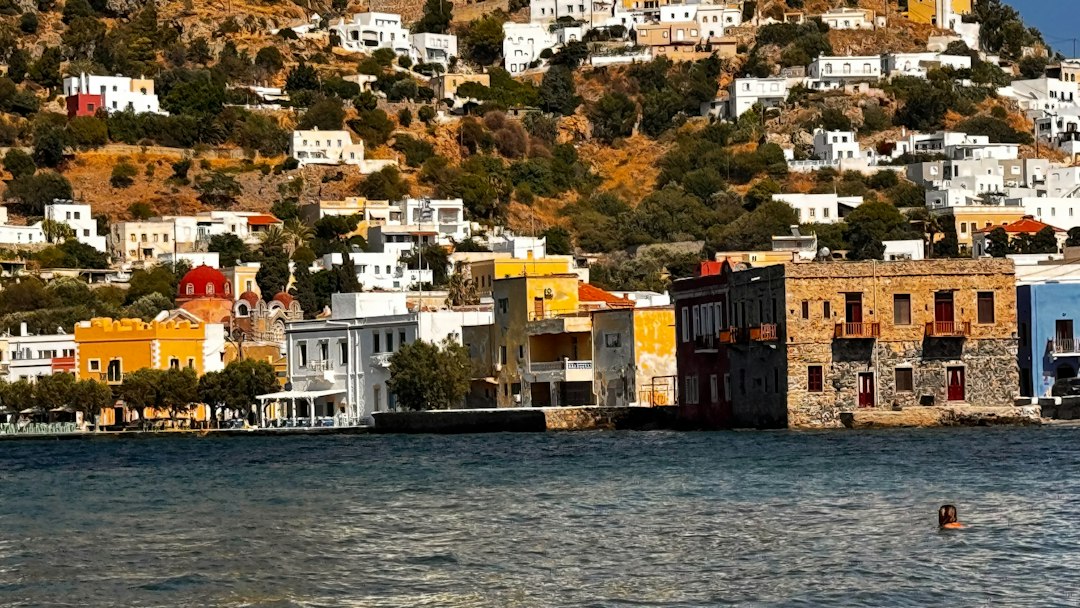
The Castle of Panteli (Kastro) is the island’s defining landmark — a Byzantine fortress with intact walls and a church containing frescoes, perched above Pandeli Bay with views reaching to Kalymnos and Kos. Lakki’s Italian Rationalist architecture is unique in Greece: a planned 1930s grid of circular plazas and Fascist-era public buildings with barely a tourist in sight. The War Museum in Merikia documents the 1943 Battle of Leros, one of the most significant WWII Aegean engagements. The hilltop capital Platanos, with its windmills and neoclassical houses, is worth an hour’s exploration. The Leros Archaeological Museum in Agia Marina covers finds from the island’s ancient history.
What watersports activities are available on Leros?
Paddleboarding, kayaking, and snorkelling are the main watersports options. Rental equipment for stand-up paddleboards and kayaks is available on Vromolithos and Alinda beaches in summer, at roughly €10–€15 per hour. Snorkelling is rewarding around the rocky headlands near Blefoútis and the islets off Gourna Bay. Sailing day trips and boat rentals (with skipper) depart from Agia Marina — these offer access to otherwise unreachable coves and neighbouring islets. Scuba diving infrastructure on Leros itself is limited; for organised dive courses and boat dives, Kalymnos (30 minutes away by hydrofoil) has a more established dive-operator scene.
What is the culinary highlight of Leros?
Fresh seafood, particularly octopus and sea bream, is the culinary centrepiece of Leros. Octopus dried on lines outside tavernas in Pandeli harbour — a classic Aegean image — is grilled and served with lemon and capers; expect to pay €10–€14 for a portion. Local fishermen supply the restaurants directly, so catch quality is high. Marides (whitebait) fried in olive oil are a cheap and typical starter at around €6–€8. The island produces a modest amount of local olive oil and honey, sold at the small market in Platanos. Worth knowing: Leros has no single signature dish unique to the island, but the combination of fresh fish, Dodecanese-style mezedes, and local wine at Pandeli quay is an experience that defines the visit.
Which parts of Leros are still off the beaten track?
The northern tip of the island around Blefoútis and the western bay of Gourna remain genuinely quiet. The village of Temenia in the interior sees almost no tourist foot traffic and gives a sense of rural Dodecanese life unchanged by tourism. The small islet of Archangelos, just off the coast, is reachable by local boat and is virtually unvisited. The southern cape near Xirokambos sees day-trippers from the ferry but empties completely by late afternoon. Tip: hiring a small motorboat for a day (around €80–€120, available from Agia Marina) lets you access coves with no road access at all — this is where the island’s most private swimming spots are found.
How many days do I need on Leros?
3 full days is the comfortable minimum; 5–6 days allows a relaxed, thorough visit. With 3 days you can cover the Castle of Panteli, a day at Blefoútis beach, the Lakki architecture walk, and dinner on Pandeli harbour. With 5 days you can add a boat day trip to Lipsi or Arki (small islets 1–2 hours away), explore the WWII War Museum, and hike between Platanos and the windmills. Compared to Kalymnos (larger, more dramatic landscapes, 30 minutes away) or Patmos (more monastic and culturally intense, roughly 1.5 hours by ferry), Leros suits a slower pace — it rewards those who stay longer, not those rushing through on a multi-island itinerary.
Leros at a Glance
| Currency | EUR (€) |
|---|---|
| Official language | Greek |
| Time zone | UTC+02:00 |
Source: Wikidata, retrieved October 2026.
Greece › Leros
More Destinations in Greece
Essential Resources for Planning Your Trip to Leros
- Leros — official visitor information
- Wikivoyage: Leros — community travel guide & practical tips
- Wikipedia: Leros — history, geography & background
- A Guide to Leros by Matt Barrett — how to get there and around
Data Sources
Key facts on this page (population, currency, language, time zone) come from Wikidata, climate figures from Open-Meteo. The retrieval date is shown next to the facts table.