
Porto Santo: The Complete Travel Guide (2026)
Last reviewed: October 2026 · key facts checked against Wikidata
Porto Santo Weather by Month: When to Go
| Month | Day | Night | Sea | Rain days | Rain mm | Wind km/h | Good for |
|---|---|---|---|---|---|---|---|
| Jan | 19° | 14° | 20° | 13 | 81 | 18 | – |
| Feb | 18° | 14° | 19° | 12 | 73 | 19 | – |
| Mar | 19° | 14° | 19° | 13 | 75 | 20 | – |
| Apr | 20° | 15° | 19° | 11 | 60 | 18 | Hike |
| May | 21° | 16° | 20° | 11 | 40 | 18 | Hike |
| Jun | 23° | 18° | 21° | 9 | 62 | 19 | – |
| Jul | 25° | 20° | 23° | 5 | 17 | 20 | SwimHike |
| Aug | 26° | 21° | 24° | 6 | 21 | 19 | Swim |
| Sep | 25° | 20° | 24° | 12 | 46 | 17 | SwimHike |
| Oct | 24° | 19° | 24° | 13 | 68 | 16 | Swim |
| Nov | 21° | 17° | 23° | 15 | 88 | 17 | – |
| Dec | 19° | 15° | 21° | 15 | 93 | 18 | – |
Sources: ERA5 reanalysis via Open-Meteo, 2016–2025 (10-year average) for air temperature, rain and wind (average daily maximum); Open-Meteo Marine API, 2023–2025 for sea surface temperature. A rain day has at least 1 mm. Area averages; individual years vary.
Porto Santo Travel Guide: Everything You Need to Know (2026)
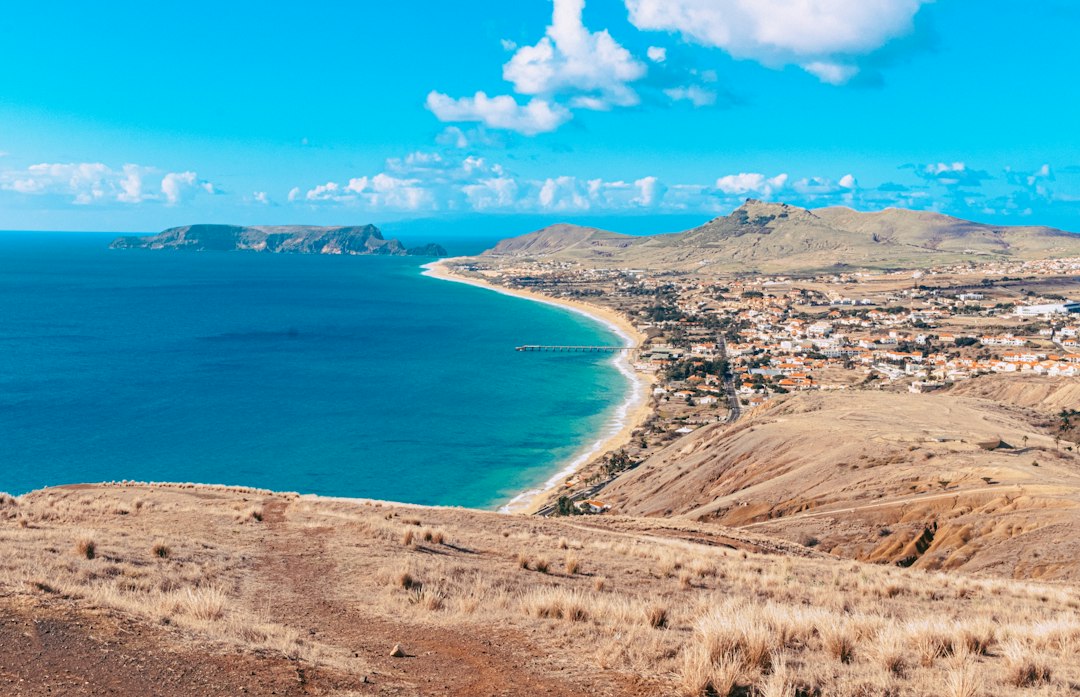
Porto Santo is a small Portuguese island of 5,149 residents sitting 43 kilometres northeast of Madeira in the North Atlantic Ocean, at an elevation reaching 402 metres above sea level at its highest point. Unlike the lush, volcanic drama of Madeira, Porto Santo is defined by its 9-kilometre golden-sand beach — one of the longest uninterrupted sandy stretches in the Atlantic — and a dry, sun-drenched microclimate that sets it firmly apart from its famous neighbour. The island is also historically noted as the birthplace of Christopher Columbus’s wife, Filipa Moniz, and Columbus himself lived here briefly in the 1470s.
Three Things Not to Miss in Porto Santo
- Porto Santo’s 9-Kilometre Golden Beach — An almost car-free Atlantic shoreline stretching 9 km — the longest sandy beach in Portugal.
- Casa Museu de Cristóvão Colombo — The house where Christopher Columbus reportedly lived in the 1470s, now a dedicated museum in Vila Baleira.
- Pico do Facho Viewpoint — The island’s highest accessible peak at 517 metres offers panoramic views across the entire island and open Atlantic.
Scroll down for our complete travel guide with tips on getting there, where to stay, costs and more.
Reaching Porto Santo
How do I get to Porto Santo — by flight or ferry from Madeira?
Both options are viable, but each suits a different traveller. Flights on SATA/Azores Airlines take roughly 15 minutes from Funchal’s Cristiano Ronaldo International Airport (FNC) — quick and convenient, but luggage allowances can be tight on small inter-island aircraft. The Porto Santo Line ferry from Funchal takes approximately 2 hours 30 minutes and allows you to bring a car, bikes, and bulkier luggage. Worth knowing: ferry crossings can be rough in winter swells, and the service is occasionally cancelled due to sea conditions. For a beach holiday, the ferry is popular in summer precisely because it lets you bring your own vehicle. Check current schedules at Portosantoline.pt and book in advance for July–August.
Which airport or ferry port is the best starting point for Porto Santo?
Porto Santo has its own small airport, Aeroporto do Porto Santo (PXO), located just outside Vila Baleira, the island’s only town, roughly 2 kilometres from the main beach strip. Flights arrive directly from Lisbon (about 1 hour 45 minutes) on TAP Air Portugal, as well as seasonally from other Portuguese and European cities. The ferry terminal is also in Vila Baleira, so both entry points deposit you directly in the centre of island life. Tip: arriving by plane is faster and avoids sea-sickness risk, while the ferry terminal offers the convenience of driving your car straight off onto the island’s roads.
How long does the ferry crossing to Porto Santo take?
The Porto Santo Line ferry from Funchal (Madeira) to Porto Santo takes approximately 2 hours 30 minutes each way. The vessel, the MV Lobo Marinho, is a roll-on/roll-off passenger and car ferry that departs daily in summer, with reduced frequency in winter. A round trip typically allows a day-trip itinerary, but the ferry also operates as an overnight option on certain schedules, letting you maximise time on the island. Caveat: in winter months (November–February), crossings can be suspended at short notice due to Atlantic swells. Always confirm departure status with Portosantoline.pt within 24 hours of travel during off-peak season.
What does a flight or ferry to Porto Santo cost?
Ferry tickets (Funchal–Porto Santo return, passenger only) typically range from about €55–€80 per person; taking a car adds roughly €80–€120 each way — verify exact fares at Portosantoline.pt. Flights from Lisbon on TAP Air Portugal start from approximately €80–€150 one way depending on season and advance booking; inter-island flights from Funchal on SATA range from about €40–€90 one way. Tip: booking 6–8 weeks ahead for summer travel (July–August) can cut costs significantly, as Porto Santo is popular with Portuguese mainland holidaymakers and prices spike sharply in peak weeks. Check TAP.pt and Azoresairlines.pt for current fares.
Are overnight ferry crossings to Porto Santo worth it?
Yes, if your schedule allows — the Porto Santo Line occasionally operates sailings that let passengers rest on board, saving a night’s accommodation cost. The crossing of 2 hours 30 minutes is not truly an overnight journey in the classic sense (unlike long-haul Portuguese mainland ferries), but some evening departures arrive late enough to count as a practical overnight option. Worth knowing: cabin or sleeping berth availability is limited and books out fast in summer; standard seating is far less comfortable for evening crossings. If you are bringing a car and travelling in July–August, combining the ferry with a day-trip from Madeira to sample the island before committing to a multi-night stay is a smart strategy.
Transport on Porto Santo
Do I need a rental car or scooter on Porto Santo?
A rental car or scooter adds significant freedom, but is not strictly essential if you are beach-focused. The main 9-kilometre beach runs the length of the southern coast and is walkable from Vila Baleira accommodations. However, reaching the volcanic northern interior, the Pico do Facho viewpoint, the Fonte da Areia sandstone formations, and quieter coves requires your own wheels. Rental cars on the island cost approximately €30–€60 per day; scooters and quads are available for roughly €25–€45 per day from agencies in Vila Baleira. Caveat: in July and August, rental vehicle supply is tight — pre-book online before arrival. The island is only about 11 km long, so a scooter is genuinely sufficient for most itineraries.
Are there bus connections between towns on Porto Santo?
There is a limited public bus service, but it covers only the main corridor between Vila Baleira and points along the beach road. Buses are infrequent — typically 4–6 departures per day on the main routes — and schedules are reduced significantly outside summer months. The service is operated by the Câmara Municipal do Porto Santo and is best used for simple transfers between the town centre and the beach strip. For exploring the island’s northern hills, the Morenos area, or the geological formations near Camacha, public buses are not a practical option. Tip: taxi services are available in Vila Baleira and reasonably priced for short hops; agree a fare before departure.
What does a rental car cost on Porto Santo — and where do I hire one?
Expect to pay approximately €35–€60 per day for a small car on Porto Santo in shoulder season; prices climb to €55–€80 per day in July–August. Reputable local agencies include Moinho Rent a Car and Auto Jardim, both with desks at Porto Santo Airport (PXO) and in Vila Baleira town centre. International brokers such as Rentalcars.com also list Porto Santo suppliers. Worth knowing: the island’s roads are short — the longest route is roughly 11 km end to end — so a basic economy car is more than sufficient. Fuel is available at the single petrol station in Vila Baleira. Book at least 3–4 weeks in advance for August arrivals to avoid being left without a vehicle.
Which parts of Porto Santo are accessible by public transport?
The beach strip and Vila Baleira town centre are the only zones reliably served by public transport on Porto Santo. The municipal bus runs along the Rua Dr. Nuno Silvestre Teixeira beach road, connecting the hotel zone at Campo de Baixo with the town centre approximately every 1–2 hours in summer. The northern villages of Camacha, Serra de Dentro, and the area around Pico do Facho have no meaningful bus service. Worth knowing: Porto Santo is a small island (only about 42 square kilometres in area), so a taxi from Vila Baleira to any point on the island rarely costs more than €10–€15. For true flexibility, two-wheel rental remains the most practical and affordable option.
Can I cycle around Porto Santo island?
Yes — Porto Santo is genuinely cycle-friendly by Atlantic island standards. The island measures only about 11 km at its longest point, and the flat southern beach road is ideal for casual cycling. Electric bike and standard bicycle rentals are available in Vila Baleira for approximately €15–€25 per day (e-bikes at the higher end). The northern interior involves steep gradients up to Pico do Facho (517 m), which is challenging on a standard bicycle but manageable on an e-bike. Tip: the beach promenade path along the 9-kilometre sandy bay is largely car-free and excellent for a leisurely morning ride. Compared to Madeira — where cycling is largely for serious mountain athletes — Porto Santo’s terrain is accessible to most fitness levels.
Accommodation on Porto Santo
Which town should I base myself in on Porto Santo?
Vila Baleira is the only real town on Porto Santo and the natural base for all visitors. With a population of roughly 5,149 across the entire island, services, restaurants, supermarkets, the ferry terminal, and the airport are all concentrated here. The beach hotel strip at Campo de Baixo, about 1–2 km west of the town centre, is where most resort-style accommodation sits directly on the sand. Choosing between Vila Baleira centre (more local atmosphere, walkable to shops) and Campo de Baixo (direct beach access) is the main decision. Tip: staying within 500 metres of the beach road gives you the best of both — easy sand access and a short walk to town restaurants and the Columbus Museum.
What does accommodation cost per night on Porto Santo?
Budget guesthouses (residenciais) in Vila Baleira start at approximately €50–€80 per night for a double room in shoulder season. Mid-range hotels along the beach strip charge roughly €100–€160 per night. The island’s flagship property, the Torre Praia Hotel (4-star, directly on the beach), runs €150–€250 per night in peak season. Self-catering apartments — a popular choice for families — average €70–€120 per night. Worth knowing: Porto Santo is noticeably more affordable than Madeira’s premium resort corridor around Funchal, but prices spike sharply in the last two weeks of July and all of August when Portuguese mainland visitors dominate. A stay at Hotel Praia Dourada offers solid mid-range value directly on the beach.
Which area of Porto Santo suits which travel style?
The beach strip at Campo de Baixo suits sun-and-sea travellers wanting direct sand access and easy watersports. Vila Baleira town centre suits those preferring local restaurants, the historic centre, and the Casa Museu de Cristóvão Colombo. The quiet northern villages — Serra de Dentro and Camacha — suit travellers seeking rural peace, stone windmills, and vineyard scenery, though a rental car is essential. Worth knowing: Porto Santo attracts a distinctly different visitor to Madeira — fewer hikers, more beach-focused families and couples seeking therapeutic seawater (the sand is locally reputed for its mineralogical properties). If you want dramatic levada walks and botanical gardens, base yourself in Funchal on Madeira, just 43 km away.
How far in advance do I need to book accommodation on Porto Santo?
Book at least 2–3 months ahead for July and August — Porto Santo is disproportionately popular with Portuguese mainland visitors escaping summer heat, and the island’s limited accommodation stock sells out fast. The main beach hotels like Torre Praia and Hotel Praia Dourada can be fully booked by April for August dates. For March–June and September–October (excellent shoulder seasons), booking 3–4 weeks in advance is generally sufficient. Worth knowing: the island has fewer than 20 hotels and guesthouses of any scale, so supply is genuinely constrained. Platforms like Booking.com and direct hotel websites both carry Porto Santo properties — direct booking sometimes yields free parking or breakfast inclusion not available through third-party sites.
Are there good apartments or villas with sea views on Porto Santo?
Yes — self-catering apartments are one of Porto Santo’s best-value accommodation options, particularly for stays of 5+ nights. Complexes like Luamar Apartamentos and Residencial Central offer sea-view units along the beach corridor at roughly €70–€120 per night. Private villas are fewer in number than on larger Atlantic islands but can be found via Airbnb and HomeAway; expect €120–€200 per night for a two-bedroom villa with a terrace in July. Worth knowing: true oceanfront villas are scarce — the southern coastline is largely taken up by hotels and the public beach promenade. For the best sunset views, look for apartments on the western edge of the beach strip near Ponta da Calheta, where the bay curves around a rocky headland.
Porto Santo Season by Season
When is the best time to visit Porto Santo?
March through May and September through November offer the best balance of warm weather, manageable crowds, and lower prices. Based on verified climate data, the recommended travel months are March, April, May, July, August, September, October, November, and December. July and August bring the warmest sea temperatures (around 23–24°C) but also the peak mainland Portuguese tourist influx. The spring shoulder season (April–May) is ideal: warm enough for swimming, the island is quieter, and wildflowers briefly colour the otherwise dry volcanic landscape. Worth knowing: Porto Santo is significantly drier and sunnier than Madeira year-round, making it viable even in December and January for mild Atlantic winter escapes, unlike most beach destinations.
What is the weather like on Porto Santo throughout the year?
Porto Santo has a warm, semi-arid Atlantic climate — sunnier and drier than nearby Madeira, with mild temperatures year-round. Summers (June–September) are warm and dry, with daytime highs typically around 26–28°C; winters (December–February) are mild, rarely dropping below 14–16°C. The island sits at UTC+00:00 and receives fewer rainy days than Madeira due to its lower elevation (max 517 m at Pico do Facho versus Madeira’s 1,862 m). Atlantic trade winds keep summer heat manageable but can make beach days breezy. Worth knowing: the dry, low-humidity climate is why Porto Santo markets itself as a therapeutic destination — the beach sand is rich in minerals and the air is notably clear. Pack a windbreaker even in August.
When does Porto Santo get overcrowded?
The last two weeks of July and all of August are Porto Santo’s peak congestion period. The island’s population of 5,149 can effectively multiply several times over during these weeks as mainland Portuguese tourists arrive in force, filling the ferry and every hotel room. The 9-kilometre beach, while long enough to absorb crowds, sees umbrella density increase sharply around the Vila Baleira end nearest the hotels. Restaurants queue, rental cars disappear, and ferry crossings sell out. Tip: arriving mid-week rather than on weekends reduces congestion at the ferry terminal significantly. Compared to similarly sized Atlantic beach islands, Porto Santo’s season is shorter and more compressed — making June and September genuinely relaxed alternatives.
Is there a worthwhile shoulder season on Porto Santo?
April–June and September–October are excellent shoulder seasons and we recommend them for most travellers. Sea temperatures in September reach around 23°C — effectively summer swimming conditions — while visitor numbers drop sharply after the first week of September as mainland schools reopen. Spring (April–May) brings the island’s brief green season, with temperatures around 20–22°C and almost no crowds. Accommodation prices in shoulder season run roughly 20–35% lower than August peaks. Worth knowing: Porto Santo’s shoulder season offers something Madeira cannot match — a virtually empty 9-km beach in warm sunshine. For comparison, Madeira in October is peak hiking season and busy; Porto Santo in October is pleasantly quiet and still warm enough for swimming.
When does the beach and watersports season begin on Porto Santo?
The beach season effectively begins in late May when sea temperatures reach approximately 20°C and consistent sunshine makes all-day beach sessions comfortable. Watersports operators — surfing schools, windsurfing rental, and stand-up paddleboard hire — typically open their full schedules from June 1 onwards. The Atlantic surf season peaks between October and March, when swell from the north-northwest generates the best waves for surfing, particularly at Ponta da Calheta on the western tip. Worth knowing: windsurfing is a Porto Santo speciality — the consistent trade winds and shallow bay make it one of the Atlantic’s better beginner-to-intermediate windsurfing locations. Operators like Porto Santo Surf School offer lessons; check their websites for exact season opening dates and current pricing.
Budgeting for Porto Santo
What does a daily budget cost on Porto Santo?
A realistic daily budget is approximately €70–€100 per person in mid-range travel style (excluding accommodation). Breakdown: a sit-down lunch at a local restaurant in Vila Baleira costs roughly €10–€15; dinner at a mid-range seafood restaurant €20–€35; a coffee and pastry €2–€3. Add a rental scooter (€25–€35/day) and one paid activity, and you reach €100–€130 easily. Beach access itself is free. For a budget traveller using the municipal bus, self-catering, and skipping paid activities, €40–€55 per day is achievable. Worth knowing: Porto Santo is modestly cheaper than Funchal (Madeira) for dining and accommodation, but imported goods are pricier than on the mainland due to island logistics costs.
Is Porto Santo more expensive than the Portuguese mainland?
Yes — Porto Santo is moderately more expensive than the Portuguese mainland for everyday goods, particularly supermarket items and petrol, because nearly everything is shipped in. Restaurant meals are comparable to mid-sized Portuguese mainland cities: a prato do dia (daily lunch special) costs about €9–€12 in local restaurants in Vila Baleira, similar to Lisbon neighbourhood eateries. Accommodation, however, is cheaper than Lisbon or Porto city centre hotels. Worth knowing: the price premium versus the mainland is most visible in supermarkets — a bottle of water or packet of biscuits can cost 20–30% more than Lisbon prices. Compared to Madeira’s tourist hotel strip in Funchal, Porto Santo’s overall visitor cost is slightly lower, largely because its dining scene is less upscale.
What expenses are unavoidable on Porto Santo?
Ferry or flight costs and ground transport are unavoidable — the island has no free shuttle service, and public buses are too limited for most itineraries. Budget for at least €55–€80 return ferry per person (or similar for flights) plus €25–€60 per day for a scooter or car rental. Sun protection is a practical unavoidable cost: Porto Santo’s combination of Atlantic UV, white sand reflection, and consistent sunshine burns faster than most visitors expect — quality sunscreen at the island’s small pharmacies costs €15–€25 per bottle. Worth knowing: umbrella and sunbed hire on the main beach (operated by private concessions near hotels) costs approximately €10–€15 per day for a pair — not obligatory, but a practical expense for a long beach holiday.
What does food cost on Porto Santo — local restaurant prices versus tourist prices?
A prato do dia at a local restaurant in Vila Baleira costs €9–€12, including soup, main course, and often a drink. Seafood mains at mid-range restaurants run €14–€22. Tourist-facing beach restaurants near the hotel strip charge roughly €18–€30 for a main course. Fresh fish — particularly lapas (limpets) grilled with garlic and butter, the island’s signature starter — costs around €8–€12 per portion. Worth knowing: the clearest price divide is between restaurants on the Rua Dr. Nuno Silvestre Teixeira beach promenade (tourist pricing) and those two streets back into Vila Baleira town centre (local pricing). A supermarket picnic from Minipreço or Continente in Vila Baleira is the most budget-friendly option for lunch.
What are the best beaches on Porto Santo?
The main 9-kilometre golden bay running the full length of the southern coast is Porto Santo’s defining feature and genuinely one of the Atlantic’s finest sandy beaches. The western end near Ponta da Calheta is the quietest, with cleaner water and fewer sunbeds — ideal for families. The central section near Campo de Baixo is the most accessible but most crowded in August. The small rocky cove at Zimbralinho, on the southeastern tip, is reached by a short walk or scooter ride and offers snorkelling in clear water with almost no crowds. Worth knowing: the beach sand is promoted for its therapeutic mineral content (magnesium and calcium-rich) and is used in locally offered thalassotherapy treatments at Torre Praia Hotel’s wellness centre.
What to Do on Porto Santo
What are the top sights beyond the beach on Porto Santo?
Casa Museu de Cristóvão Colombo in Vila Baleira documents the island’s connection to Christopher Columbus, who lived here in the 1470s — entry costs approximately €3–€5; verify at the museum directly. Pico do Facho (517 m) is the island’s highest accessible viewpoint and offers a 30-minute walk from the road to a panorama of the entire island. The Fonte da Areia (Fountain of Sand) in the northwest is an unusual sandstone formation with naturally sculpted layers. The windmills of Camacha in the interior are a traditional landmark. Worth knowing: sightseeing beyond the beach takes only 1–2 days — Porto Santo is primarily a beach destination, not a cultural one. For richer cultural depth, Madeira’s Funchal (43 km away, 2.5 hours by ferry) offers far more.
What watersports activities are available on Porto Santo?
Windsurfing, kitesurfing, surfing, snorkelling, and stand-up paddleboarding are all available on Porto Santo. The consistent north-northeast trade winds make the southern bay a reliable windsurfing spot from June through October; equipment hire and beginner lessons are offered by Porto Santo Surf School and similar operators on the beach strip. Surfing is better at Ponta da Calheta on the western tip in autumn and winter swells. Scuba diving is offered by local operators — the underwater visibility around Porto Santo’s rocky reefs reaches 20–30 metres on calm days. Boat trips for fishing or coastline exploration depart from Vila Baleira harbour. Lesson prices typically range from €30–€60 per session; confirm with operators directly as pricing varies seasonally.
What is the culinary highlight of Porto Santo?
Lapas (grilled limpets) are Porto Santo’s unmissable culinary experience — the island’s shellfish, plucked from Atlantic rocks, are grilled directly on the shell with garlic, butter, and a squeeze of lemon, and served at nearly every restaurant in Vila Baleira. A portion of 8–12 limpets costs approximately €8–€12. Fresh tuna (atum) is another island staple, often served as a thick steak grilled simply with local herbs. The island also produces a small quantity of Porto Santo wine from the arid northern vineyards — dry whites made from local varieties, available at the Adega do Porto Santo cooperative. Worth knowing: the culinary scene is simple and ingredient-led rather than gastronomically sophisticated — visitors expecting Madeiran restaurant variety will find Porto Santo’s dining more limited but fresher.
Which parts of Porto Santo are still off the beaten track?
The northern interior — Serra de Dentro, Serra de Fora, and the area around Camacha — sees almost no tourist foot traffic despite being reachable within 10 minutes by car from Vila Baleira. The Pico das Flores and Pico Branco volcanic peaks in the northwest offer short hikes with Atlantic panoramas and almost zero other visitors even in August. The Zimbralinho cove on the southeastern coast requires a 15-minute walk from the nearest road but rewards with clear snorkelling water and no sunbed rentals. Worth knowing: Porto Santo is already far less visited than Madeira — the island receives a fraction of Madeira’s annual tourist arrivals — so even the “main” beach at its western Ponta da Calheta end feels uncrowded compared to comparable Atlantic beach destinations in Spain or the Canaries.
How many days do I need to see Porto Santo properly?
3–5 nights is the ideal stay for most travellers. Three days lets you fully experience the 9-kilometre beach, visit the Casa Museu de Cristóvão Colombo, reach Pico do Facho by scooter, and try the northern villages. Five days allows time for a day trip back to Madeira (2.5 hours by ferry, with Funchal’s Old Town, Mercado dos Lavradores, and levada walks), watersports lessons, and a slower beach pace. Worth knowing: most visitors staying fewer than 2 nights report feeling they did not have enough beach time — the island’s appeal is deliberate decompression, not sightseeing accumulation. Compared to Madeira, where a week barely scratches the hiking and cultural surface, Porto Santo rewards slower, simpler travel.
Porto Santo at a Glance
| Population | 5,149 |
|---|---|
| Currency | EUR (€) |
| Official language | Portuguese |
| Time zone | UTC+00:00 |
Source: Wikidata, retrieved October 2026.
Portugal › Madeira › Porto Santo
More Destinations in Madeira
More Destinations in Portugal
Essential Resources for Planning Your Trip to Porto Santo
- Wikivoyage: Porto Santo — community travel guide & practical tips
- Wikipedia: Porto Santo — history, geography & background
- How to Get to Porto Santo: Flights, Ferry & Travel Tips – Kupi — how to get there and around
Data Sources
Key facts on this page (population, currency, language, time zone) come from Wikidata, climate figures from Open-Meteo. The retrieval date is shown next to the facts table.