
Kefalonia: The Complete Travel Guide (2026)
Last reviewed: October 2026 · key facts checked against Wikidata
Kefalonia Weather by Month: When to Go
| Month | Day | Night | Sea | Rain days | Rain mm | Wind km/h | Good for |
|---|---|---|---|---|---|---|---|
| Jan | 14° | 9° | 17° | 15 | 148 | 22 | – |
| Feb | 15° | 9° | 16° | 9 | 88 | 22 | – |
| Mar | 16° | 10° | 17° | 12 | 80 | 22 | – |
| Apr | 19° | 13° | 17° | 7 | 38 | 20 | Hike |
| May | 22° | 16° | 19° | 7 | 39 | 19 | Hike |
| Jun | 27° | 21° | 24° | 3 | 19 | 17 | Swim |
| Jul | 30° | 23° | 26° | 1 | 8 | 19 | Swim |
| Aug | 31° | 23° | 27° | 3 | 10 | 18 | Swim |
| Sep | 27° | 21° | 26° | 6 | 67 | 18 | Swim |
| Oct | 23° | 17° | 23° | 9 | 104 | 18 | Swim |
| Nov | 19° | 14° | 22° | 14 | 210 | 22 | – |
| Dec | 16° | 11° | 19° | 13 | 151 | 21 | – |
Sources: ERA5 reanalysis via Open-Meteo, 2016–2025 (10-year average) for air temperature, rain and wind (average daily maximum); Open-Meteo Marine API, 2023–2025 for sea surface temperature. A rain day has at least 1 mm. Area averages; individual years vary.
Kefalonia Travel Guide: Everything You Need to Know (2026)
Kefalonia, the largest of the Ionian Islands at roughly 781 km², sits off the western coast of Greece at elevations reaching 1,628 m at Mount Ainos — the highest peak in the Ionian chain. The island gained international fame after Louis de Bernières set his 1994 novel ‘Captain Corelli’s Mandolin’ there, boosting tourism significantly in the decades since. With a permanent population of 36,064, Kefalonia offers a relatively uncrowded experience compared to Corfu or Zakynthos, though peak-season pressure on key beaches is real.
Three Things Not to Miss in Kefalonia
- Myrtos Beach — Consistently ranked among Greece’s most photographed beaches, with dramatic white limestone cliffs dropping 400 m to turquoise water.
- Melissani Cave Lake — A collapsed-roof cave lake near Sami where sunlight hits the water at midday, turning it an electric cobalt blue.
- Fiskardo Village — The only village that survived the 1953 earthquake intact, preserving Venetian-era architecture along a yacht-filled harbour.
Scroll down for our complete travel guide with tips on getting there, where to stay, costs and more.
Getting to Kefalonia: Ferry or Flight
How do I get to Kefalonia — by flight or ferry?
Flying is faster and the dominant choice for most international visitors. Kefalonia International Airport (EFL), located 9 km south of Argostoli, receives direct charter and scheduled flights from major European cities, especially April through October. Ferry connections run from Patras (mainland Greece) to Sami in about 2.5–3 hours, and from Killini to Poros in roughly 1.5 hours; Ionian Ferries and Levante Ferries operate these routes — check current schedules on their official websites. Tip: Flying is far quicker, but the ferry suits travellers combining Kefalonia with the Peloponnese. Note that international ferry options are limited outside summer.
Which airport or port is the best starting point for Kefalonia?
Kefalonia International Airport (EFL) near Argostoli is the primary entry point for most visitors. It handles direct seasonal flights from the UK, Germany, and other European hubs through carriers including Ryanair, TUI, and Jet2 — frequency peaks June through September. The port of Sami on the east coast is the main ferry hub if you are arriving from Patras on the mainland. Worth knowing: EFL has limited winter service; travellers visiting November through March may need to connect via Athens Eleftherios Venizelos (ATH) and take a domestic Aegean Airlines or Sky Express flight, adding roughly 1 hour to the journey.
How long does the ferry crossing to Kefalonia take?
Journey times vary by route. Patras to Sami takes approximately 2.5–3 hours and is operated by Levante Ferries; Killini to Poros runs about 1.5 hours with Ionian Ferries; the short crossing from Pessada (Kefalonia) to Skinari (Zakynthos) takes around 30 minutes seasonally, making island-hopping straightforward. From Astakos on the mainland to Sami takes roughly 3 hours. Tip: Departure times shift seasonally — always verify on the operator’s booking portal or on ferryhopper.com before travel. Arrive at the port at least 45 minutes before car-ferry departure; deck-only passengers can board later.
What does a flight or ferry to Kefalonia cost?
Charter package flights from the UK or Germany often bundle accommodation; standalone return flights to EFL range from roughly €80–€250 depending on season and booking window — check Ryanair, TUI, or Jet2 directly for live fares. The Patras–Sami ferry costs approximately €15–€25 per foot passenger one way; bringing a car adds roughly €50–€80. The Killini–Poros crossing is in a similar range. Caveat: Fuel surcharges and port taxes are added at checkout and are not always shown in headline prices. Tip: Book ferry tickets on ferryhopper.com or directly with the operator at least 3–4 weeks ahead in July and August.
Are overnight ferries to Kefalonia worth taking?
No true overnight ferry operates to Kefalonia currently — the longest crossing (Patras–Sami at roughly 3 hours) does not justify a cabin berth. Overnight services exist further north on the Adriatic (e.g., Patras to Italy), but those do not serve Kefalonia directly. Worth knowing: If you want to arrive rested and save a hotel night, the practical alternative is a late-evening domestic flight from Athens to EFL (the Aegean or Sky Express last departures are typically around 21:00 in summer — confirm current schedules with the airlines). For travellers driving from Central Europe, an overnight Ancona–Patras or Bari–Patras ferry followed by a daytime Patras–Sami crossing is the standard overland-sea route.
Getting Around Kefalonia
Do I need a rental car or scooter on Kefalonia?
Yes — a rental car is strongly recommended for seeing the island properly. Kefalonia covers roughly 781 km² and public bus frequency is low outside Argostoli. Key attractions like Myrtos Beach, Drogarati Cave, and the Assos peninsula are not served by regular buses. Car rental rates start at roughly €35–€55 per day for a compact in peak season from operators at EFL airport and in Argostoli. Caveat: Roads in the north toward Fiskardo and around Mount Ainos are narrow and winding — a compact or small SUV handles them better than a large vehicle. Scooters suit shorter itineraries based in Lassi or Argostoli but are not practical for the full island.
Are there buses between towns on Kefalonia?
KTEL Kefalonia operates scheduled bus routes, but coverage is limited and infrequent. The main corridor runs from Argostoli to Sami, Poros, and Skala roughly 2–4 times daily depending on season — check current timetables at the KTEL terminal on 25th Martiou Street in Argostoli or on the KTEL Kefalonia website. Fiskardo in the north has no reliable year-round bus connection. Tip: Buses work adequately for a single day trip between Argostoli and Sami, but building a multi-day itinerary around bus schedules is impractical. For visitors without a car, licensed taxis from Argostoli Taxi Stand on the main square are available but expensive for longer distances.
What does a rental car cost on Kefalonia — and where do I hire one?
Compact car rental runs approximately €35–€60 per day in peak season (July–August); shoulder-season rates (May–June, September) drop to roughly €25–€40 per day. Major international desks (Europcar, Hertz, Avis) operate at EFL airport, and local agencies in Argostoli town centre often undercut airport prices by 10–15%. Full insurance including CDW (Collision Damage Waiver) is worth adding — rocky coastal roads and tight village lanes make minor scrapes a real risk. Tip: Book at least 4–6 weeks ahead for July and August; on-arrival availability is limited and prices surge. Fuel costs are paid separately; a full tank costs roughly €70–€90 depending on vehicle size.
Which parts of Kefalonia are accessible by public transport?
Argostoli, Sami, Skala, and Poros are the towns best served by KTEL Kefalonia buses, with 2–4 daily departures on main routes in season. The beach at Lourdas occasionally appears on summer timetables. Assos, Fiskardo, Agia Efimia, and Myrtos Beach are not reliably served — reaching them without a car requires a private taxi or an organised tour. Worth knowing: Argostoli itself is walkable; the town centre, the Drapano Bridge, and the nearby Lassi peninsula beaches are reachable on foot or by local taxi from the bus terminal. Visitors relying solely on public transport will miss a significant portion of the island’s landscapes.
Can I cycle around Kefalonia?
Cycling across the full island is not practical for most visitors. Kefalonia’s terrain is mountainous, with gradients reaching the 1,628 m summit of Mount Ainos, and the main coastal roads carry fast-moving traffic in summer with narrow or non-existent shoulders. Short recreational cycling is feasible around the flat Argostoli lagoon area and on quieter inland roads in the Livathos plain south of the capital. Tip: E-bike rental is available from a few operators in Argostoli and at Lassi, making moderate day rides to nearby beaches manageable. For a cycling-focused Ionian holiday, Lefkada (connected to the mainland by a causeway) offers flatter terrain and dedicated cycling infrastructure.
Where to Stay on Kefalonia
Which town should I base myself in on Kefalonia?
Argostoli suits first-time visitors — it is the island’s capital, the main ferry hub for some routes, has the densest concentration of restaurants, supermarkets, and the KTEL bus terminal. Fiskardo in the north is quieter and more picturesque but requires long drives to reach southern beaches. Skala and Katelios in the southeast offer calmer, resort-oriented stays with good beaches nearby. Agia Efimia works well as a central base for divers using the Sami coastline. Caveat: Wherever you stay, budget for significant driving — Argostoli to Fiskardo is roughly 50 km via the inland route, taking about 1 hour. We recommend Argostoli for flexibility and logistics.
What does accommodation cost per night on Kefalonia?
Budget guesthouses and studios in Argostoli start at roughly €40–€60 per night in shoulder season. Mid-range hotels and apartments — the dominant accommodation type — run €80–€150 per night in July and August. Boutique hotels in Fiskardo and luxury villas with private pools in the Lourdas or Lassi area cost €200–€500+ per night at peak times. Worth knowing: Self-catering apartments represent excellent value for families and are widely available through Airbnb and Booking.com. Prices in Fiskardo carry a premium of roughly 20–30% over comparable quality in Argostoli due to the village’s prestige and smaller supply.
Which area of Kefalonia suits which travel style?
Argostoli suits city-curious travellers who want services, nightlife, and a central base. Fiskardo appeals to yacht charterers and couples seeking Venetian ambience and upscale dining. Skala and Lassi are family-friendly resort strips with organised beaches and water sports. Assos village on its narrow isthmus attracts photographers and those wanting seclusion. Agia Efimia is the base of choice for divers and snorkellers exploring the Blue Grotto and the reefs off Sami Bay. Tip: If your priority is Myrtos Beach, staying in Assos or the Pylaros area cuts the drive to under 15 minutes, versus nearly 45 minutes from Argostoli.
How far in advance should I book accommodation on Kefalonia?
Book at least 3–4 months ahead for travel in July and August. Popular properties in Fiskardo and sea-view villas in Lourdas routinely sell out by April for the peak summer period. Shoulder season (May–June, September–October) can be booked 4–6 weeks in advance without major issues, though good-value mid-range options still disappear quickly. Caveat: Kefalonia has limited large hotel inventory — most properties are small family-run studios or boutique guesthouses, so supply is genuinely constrained at peak times. Last-minute arrivals in August face significantly higher prices or poor location choices. We recommend confirming cancellation policies carefully, as summer bookings are often non-refundable after a short window.
Are there good apartments or villas with sea views on Kefalonia?
Yes — villas and sea-view apartments are among Kefalonia’s strongest accommodation offers. The Lourdas hillside, the Spartia area south of Argostoli, and the terraces above Assos deliver panoramic Ionian views. Agencies such as Simpson Travel, CV Villas, and James Villas curate verified villa rentals with private pools; nightly rates range from roughly €150 for a smaller villa to €600+ for larger properties in August. Tip: Villas booked through specialist operators typically include linen, welcome packs, and local support contacts — useful on an island where English-language help is unevenly distributed. Book through operators that show owner-verified photos and include pool heating cost disclosures upfront.
Best Time to Visit Kefalonia
When is the best time to visit Kefalonia?
July and August are statistically the best months based on climate data — warm, dry, and reliably sunny. Late May through June and September offer nearly identical beach weather with noticeably fewer crowds and lower prices — we consider these the optimal windows for most independent travellers. October still sees warm sea temperatures (around 22–23°C) and is excellent for hiking Mount Ainos National Park. Caveat: Kefalonia lies in an earthquake-prone zone and occasionally experiences strong Ionian winds (the Maistros) in August that can close beaches temporarily. Winter (November–March) sees many restaurants and hotels in resort areas shut entirely, making the island feel sparse outside Argostoli.
What is the weather like on Kefalonia throughout the year?
Kefalonia has a Mediterranean climate with hot, dry summers and mild, wet winters. Argostoli (sea level) sees July–August highs around 32–34°C; the mountain interior around Mount Ainos at 1,628 m can be markedly cooler. Winter (December–February) brings rain and temperatures around 12–15°C in coastal areas. Spring (April–May) is green and blooming. Worth knowing: Kefalonia is significantly wetter in winter than most Aegean islands — it receives some of the highest annual rainfall in Greece, which explains the lush vegetation and the island’s famous fir forests on Ainos. This also means spring water features like Melissani Cave and Karavomylos Lake are most dramatic after winter rains.
When does Kefalonia get overcrowded?
Mid-July through late August is when Kefalonia feels most crowded — primarily Myrtos Beach, Antisamos Beach, and Fiskardo village. Myrtos in particular has a single access road and a small car park; by 10:00 in August it fills completely, and queues form. Worth knowing: The island is significantly less impacted by cruise tourism than Corfu or Santorini, so overcrowding is concentrated at specific iconic spots rather than island-wide. Arriving at top beaches before 9:00 or after 17:00 avoids the worst congestion. Compared to nearby Zakynthos (about 1.5 hours by seasonal ferry), Kefalonia retains a calmer atmosphere overall.
Is there a worthwhile shoulder season on Kefalonia?
Yes — late May through June and September are excellent for most travellers. Sea temperatures hit 22–24°C by late June; by September they remain warm at 24–25°C. Prices for accommodation and car hire drop 15–30% compared to August. Most restaurants, boat tours, and attractions remain open. Tip: The Robola wine harvest in the Omala Valley typically falls in early September, offering an authentic local experience. The hiking season on Mount Ainos and the fir forest trails runs best from May to early June and again in September when temperatures are manageable. Only the very shortest ferry crossings (e.g., Pessada–Skinari to Zakynthos) sometimes reduce frequency after mid-September.
When does the beach and watersports season begin on Kefalonia?
Organised beach facilities open from late May, and sea temperatures are swimmable (roughly 20–22°C) by mid-May for cold-water tolerant swimmers. Water sports operators at Lassi, Lourdas, and Skala — offering jet skis, pedal boats, banana boats, and parasailing — typically set up from early June and operate through late September. Scuba diving with certified operators like Aquatic Diving Center in Sami and Padi-certified schools at Agia Efimia runs May through October. Caveat: The watersports infrastructure at Kefalonia’s beaches is good but not as extensive as on Corfu’s Dassia or Gouvia coasts — families should confirm specific activity availability with operators before booking travel dates.
What Kefalonia Costs
What does a daily budget cost on Kefalonia?
A budget traveller staying in a studio, eating at tavernas, and self-catering for one meal can manage on roughly €60–€80 per day excluding car hire. A mid-range day — comfortable hotel, two sit-down meals, one activity, and car hire share — costs approximately €120–€180 per person. A comfortable/luxury day in a villa with dining at Tassia restaurant in Fiskardo or similar runs €250+. Tip: Car hire is the largest discretionary expense; sharing costs across two or more people significantly reduces the per-person daily total. Fuel for a full day of island driving typically adds €15–€25 to your budget.
Is Kefalonia more expensive than the Greek mainland?
Yes — expect to pay 15–25% more than comparable mainland destinations for food, accommodation, and services. Island logistics (ferry freight costs, lower competition) push prices higher. A taverna meal in Argostoli runs roughly €12–€20 per person for a main course and drink; in Fiskardo the same meal costs €20–€35. Compared to Corfu Town (another Ionian island, roughly 3 hours north by ferry), Kefalonia is broadly similar in price. Worth knowing: Supermarket prices at chains like AB Vassilopoulos in Argostoli are close to mainland prices — self-catering for breakfasts and lunches is an effective way to manage costs without sacrificing the quality of one good dinner at a local taverna.
What expenses on Kefalonia are unavoidable?
Car rental is effectively unavoidable for any visitor wanting to see more than Argostoli — budget €35–€55 per day plus fuel. Ferry or flight costs to reach the island are the other fixed expense. Once on the island, cash for small tavernas, market stalls, and cave entry fees is essential — not all smaller venues accept cards. Entry to Melissani Cave costs approximately €7–€9 per adult (verify current pricing at the ticket booth in Karavomylos); Drogarati Cave charges a similar amount. Tip: Port taxes and airport departure fees are typically included in flight tickets now, but ferry surcharges can add €3–€5 per booking — read the fee breakdown before confirming.
What does food cost on Kefalonia — local vs tourist prices?
A village taverna lunch (grilled meat or fish, salad, bread, local wine or water) runs roughly €12–€18 per person in inland or less-visited spots like Omala or Kourkoumelata. Beachfront restaurants in Lassi or Skala charge €18–€28 for a similar meal. Fresh fish is priced by weight — typically €45–€65 per kg — making a full fish dinner for two a significant expense. Worth knowing: The bakeries and small cafés in Argostoli’s central market area (around Valianou Square) offer budget breakfasts for €3–€5. The local Robola white wine from the Omala Valley is excellent and costs roughly €5–€8 per half-litre carafe at a taverna.
What are the best beaches on Kefalonia?
Myrtos Beach on the west coast is the island’s signature beach — a 1.2 km arc of white pebbles beneath towering white cliffs, accessible via a steep road with limited parking. Antisamos near Sami is a pebbly cove used in filming ‘Captain Corelli’s Mandolin’ and is backed by dense hillside greenery. Xi Beach on the south coast has distinctive red-sand geology and calm, shallow water ideal for families. Petani Beach in the northwest rivals Myrtos in drama but is less visited. Tip: Myrtos has no shade, minimal facilities, and strong afternoon waves — bring water and an umbrella, and arrive before 09:30 in peak season to secure a spot.
Beaches & Experiences on Kefalonia
Top sights on Kefalonia beyond the beaches?
Melissani Cave Lake near Karavomylos offers a short boat ride through a collapsed cave lit by a natural skylight — the midday light effect (roughly 12:00–14:00) is the most photogenic. Drogarati Cave near Sami features a 65 m-deep chamber with stalactites. Fiskardo village preserves intact Venetian architecture from before the 1953 earthquake and makes for a photogenic half-day. Mount Ainos National Park protects a unique endemic Abies cephalonica fir forest above 1,000 m. Worth knowing: The Archaeological Museum of Argostoli and the Corgialenio History Museum provide solid context on the island’s Mycenaean past and the devastating 1953 earthquake respectively.
What watersports activities are available on Kefalonia?
Kefalonia’s clear Ionian waters support a strong range of water activities. Scuba diving around the underwater caves and reefs off Sami and Agia Efimia is the standout offering — visibility regularly exceeds 30 m. Sea kayaking tours launch from Antisamos and Myrtos beaches with operators including Kefalonia Outdoor Activities. Boat charter (skippered or bareboat) from Fiskardo marina gives access to otherwise unreachable sea caves. Standard beach activities — jet skis, banana boats, paddleboards — operate at Lassi and Skala. Tip: The underwater caves near Sami, including the Fokis sea caves, are accessible only by boat — a half-day boat tour from Sami costs roughly €25–€40 per person.
What is the culinary highlight of Kefalonia?
Kreatopita Kefalonias — a rich meat pie of spiced lamb and veal baked in shortcrust pastry — is the island’s signature dish and found nowhere else in exactly this form. Robola wine, a dry white made from the indigenous Robola grape cultivated in the Omala Valley, is the essential local drink; the Robola Cooperative Winery in Omala offers tastings and is worth the 8 km drive from Argostoli. Alimono preserved citrus and thymari honey from the island’s wild thyme are quality souvenirs. Tip: For kreatopita, avoid tourist-strip restaurants and look for family bakeries in Argostoli market area or village kafeneions in Valsamata and Troianata where it is made fresh daily.
Which parts of Kefalonia are still off the beaten track?
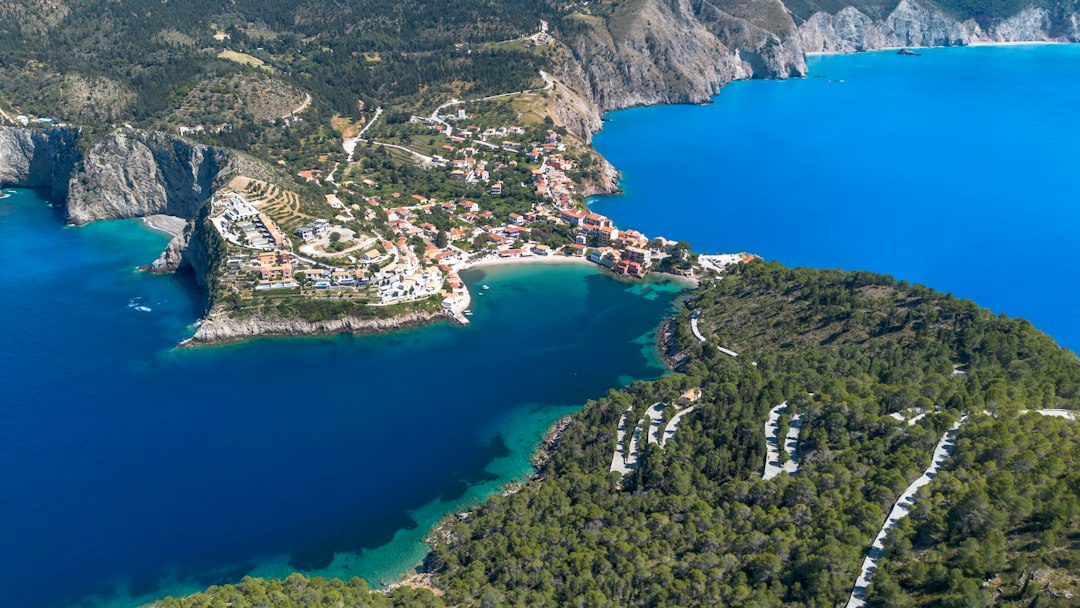
The Pylaros region in the northeast — a series of quiet villages including Divarata and Vasilikiades — sees a fraction of the traffic that reaches Fiskardo. The Paliki Peninsula (the western lobe of the island containing Lixouri, Kefalonia’s second town at roughly 8,000 residents) is undervisited despite having excellent beaches like Xi and Mega Lakos. Reached by a 20-minute ferry from Argostoli that runs roughly every 30 minutes in summer, Lixouri rewards visitors with authentic tavernas and zero tourist infrastructure. Tip: The coastal path between Assos village and the Assos Castle headland (16th century Venetian fortress) takes about 20 minutes on foot and has outstanding views with almost no other visitors before 09:00.
How many days do I need on Kefalonia?
A minimum of 5 days is needed to cover the island’s main highlights without rushing. A 7-day stay allows a relaxed pace: two days based near Argostoli for the south and centre, two days exploring the north including Fiskardo and Myrtos, one day on the Paliki Peninsula, and two beach days. Worth knowing: Kefalonia pairs naturally with Zakynthos (30 minutes by seasonal ferry from Pessada to Skinari) for a two-island itinerary — Zakynthos adds the famous Navagio Shipwreck Beach and is strikingly different in atmosphere. A 10-day Ionian itinerary combining Kefalonia with Ithaca (20-minute ferry from Sami) is possible and covers one of the least-touristed Ionian islands.
Kefalonia at a Glance
| Population | 36,064 |
|---|---|
| Currency | EUR (€) |
| Official language | Greek |
| Time zone | UTC+02:00 |
Source: Wikidata, retrieved October 2026.
Greece › Kefalonia
More Destinations in Ionian Islands
More Destinations in Greece
Essential Resources for Planning Your Trip to Kefalonia
- Kefalonia-Ithaca UNESCO Global Geopark — official visitor information
- Wikivoyage: Kefalonia — community travel guide & practical tips
- Wikipedia: Kefalonia — history, geography & background
- What is Kefalonia’s bus transport like for getting around? — how to get there and around
- Kefalonia-Ithaca UNESCO Global Geopark
Data Sources
Key facts on this page (population, currency, language, time zone) come from Wikidata, climate figures from Open-Meteo. The retrieval date is shown next to the facts table.