
Procida: The Complete Travel Guide (2026)
Last reviewed: November 2026 · key facts checked against Wikidata
Procida Weather by Month: When to Go
| Month | Day | Night | Sea | Rain days | Rain mm | Wind km/h | Good for |
|---|---|---|---|---|---|---|---|
| Jan | 13° | 7° | 16° | 12 | 95 | 20 | – |
| Feb | 14° | 8° | 15° | 11 | 89 | 20 | – |
| Mar | 16° | 9° | 15° | 13 | 86 | 20 | – |
| Apr | 18° | 11° | 17° | 10 | 62 | 19 | – |
| May | 22° | 15° | 20° | 11 | 71 | 18 | – |
| Jun | 27° | 20° | 25° | 4 | 28 | 17 | Swim |
| Jul | 30° | 23° | 27° | 3 | 14 | 17 | Swim |
| Aug | 31° | 23° | 27° | 5 | 24 | 17 | Swim |
| Sep | 26° | 19° | 26° | 10 | 105 | 17 | Swim |
| Oct | 22° | 16° | 23° | 10 | 95 | 17 | Swim |
| Nov | 18° | 12° | 20° | 16 | 203 | 20 | – |
| Dec | 15° | 8° | 18° | 11 | 114 | 19 | – |
Sources: ERA5 reanalysis via Open-Meteo, 2016–2025 (10-year average) for air temperature, rain and wind (average daily maximum); Open-Meteo Marine API, 2023–2025 for sea surface temperature. A rain day has at least 1 mm. Area averages; individual years vary.
Procida Travel Guide: Everything You Need to Know (2026)
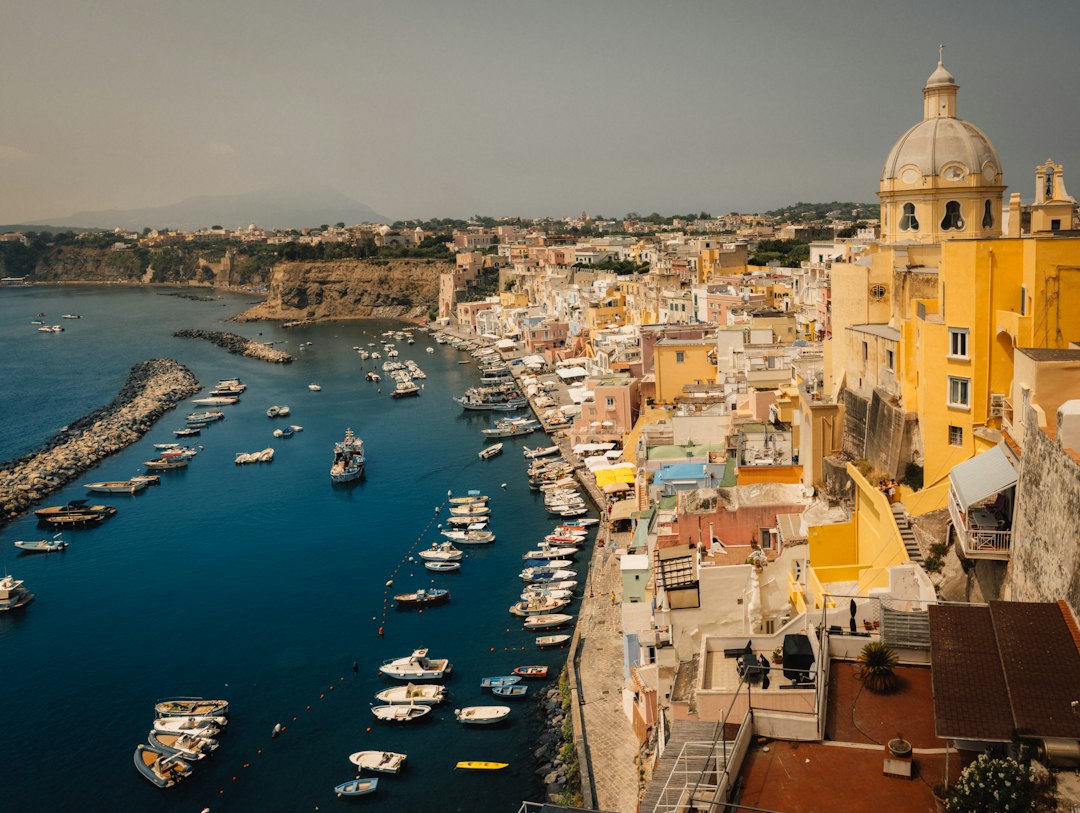
Procida is a volcanic island in the Bay of Naples, covering just 4.1 square kilometres and home to 10,092 residents — making it one of the most densely populated islands in the Mediterranean. Lying roughly 3.5 km from Cape Miseno and 8 km west of Naples, it sits at an elevation of 22 m above sea level. The island gained international attention as Italy’s Capital of Culture in 2022, and its pastel-coloured harbour of Marina Corricella has appeared in films including Il Postino.
Three Things Not to Miss in Procida
- Marina Corricella — A car-free fishing harbour lined with stacked pastel houses, one of Italy’s most photogenic waterfronts and a filming location for Il Postino.
- Terra Murata — Procida’s hilltop medieval citadel, rising to about 90 m, enclosing a 16th-century abbey and panoramic views over the Bay of Naples.
- Vivara Nature Reserve — A crescent-shaped uninhabited island tethered to Procida by a bridge, a protected migratory bird sanctuary open on guided visits.
Scroll down for our complete travel guide with tips on getting there, where to stay, costs and more.
Getting to Procida: Ferry or Flight
How do I get to Procida — by flight or ferry?
Ferry is the only way to reach Procida — there is no airport on the island. The standard crossing departs from Pozzuoli (fastest option, about 35 minutes by hydrofoil) or from Naples Calata Porta di Massa / Molo Beverello (roughly 80 minutes by ferry, 50 minutes by hydrofoil). Day-trippers from Ischia can also catch a short ferry of about 25 minutes. Operators Caremar and Medmar run car ferries; SNAV and Alilauro run hydrofoils. Worth knowing: hydrofoils are cancelled in rough seas during autumn and winter, so always check the operator’s website the morning of travel.
Which port is the best starting point for Procida?
Pozzuoli is the most practical port for most travellers arriving by car or public transport. It is reachable from Naples in about 30 minutes by the Cumana railway line to Pozzuoli station, then a short walk to the ferry dock. The Naples Molo Beverello terminal is more central for those already in the city but involves longer journey times. Tip: if you are flying into Naples Capodichino Airport (NAP), take the Alibus shuttle to Piazza Garibaldi, then the Cumana line to Pozzuoli — total transit time around 55 minutes before boarding.
How long does the ferry crossing to Procida take?
Journey time depends on the vessel and departure port. From Pozzuoli, hydrofoils take about 35 minutes; car ferries take roughly 55 minutes. From Naples Molo Beverello, the hydrofoil runs about 50 minutes and the standard ferry around 80 minutes. From Ischia (Casamicciola), the crossing is approximately 25 minutes. Services run frequently throughout the day — roughly every 1–2 hours in peak season — but evening sailings thin out considerably. Worth knowing: last ferries back to Naples typically depart Procida before 21:00; always confirm timetables directly with Caremar or SNAV, as schedules change seasonally.
What does a ferry ticket to Procida cost?
A passenger ticket from Pozzuoli to Procida costs approximately €5–€10 one way depending on the vessel (slow ferry vs. hydrofoil). From Naples Molo Beverello, hydrofoil tickets run roughly €12–€18 per person. Transporting a car costs approximately €20–€35 each way; check current rates directly with Caremar or Medmar before booking, as seasonal surcharges apply. We recommend booking car ferry space in advance during July and August, as vehicle spots sell out. Tip: foot passengers rarely need to pre-book outside peak weekends, but buying tickets at the port kiosk adds a small queue risk in high summer.
Are overnight ferries to Procida worth it?
No overnight ferries serve Procida — all crossings are short daytime services. The longest route (from Naples) takes under 90 minutes, so an overnight vessel is neither available nor necessary. The practical alternative for a very early island arrival is to stay the night in Pozzuoli, which has budget-friendly accommodation and is just a short walk from the ferry dock. Alternatively, an Ischia overnight stay works well: Ischia is a larger island with plentiful hotels, and the 25-minute Casamicciola–Procida morning crossing gets you onto Procida by 07:30 most months.
Getting Around Procida
Do I need a rental car or scooter on Procida?
A car is not necessary and is actively inconvenient on Procida. The island measures only 4.1 km², and lanes in Marina Corricella and Terra Murata are too narrow for cars. Scooter or electric golf-cart rentals near Marina Grande di Sancio Cattolico (the main ferry port) cost roughly €25–€50 per day; bicycles rent for about €10–€15 per day. Most accommodation is reachable on foot within 20 minutes of the port. Caveat: if you bring your own car via the ferry you will pay a substantial surcharge, face limited parking, and gain little advantage on an island this compact — we recommend leaving it on the mainland.
Are there buses between towns on Procida?
Yes — a small bus network (line L1 and L2) covers Procida’s main routes. Operated by EAV (Ente Autonomo Volturno), the buses connect Marina Grande, Chiaiolella, Corricella, and Terra Murata. A single ticket costs approximately €1–€1.50; check current fares with EAV directly. Buses run roughly every 20–30 minutes in summer and less frequently off-season. The island is so compact that many visitors simply walk everywhere — the cross-island distance is under 3 km. Worth knowing: in peak July–August the buses are extremely crowded; departing on foot 10 minutes earlier is often faster than waiting for the next service.
What does a rental car cost on Procida — and where do I hire one?
Traditional car hire does not exist on Procida — the island’s narrow streets and 4.1 km² area make four-wheel vehicles impractical for tourists. Instead, golf-cart (calessino) and scooter rentals are available from several small operators clustered around Marina Grande di Sancio Cattolico, the main port area. Expect to pay roughly €30–€60 per day for a golf cart and €25–€45 per day for a 50cc scooter. Operators do not always have websites; walk-up hire is the norm. Tip: bring your driving licence regardless, as most operators require it even for golf carts. Demand peaks sharply in August — aim to hire by 09:00.
Which parts of Procida are accessible by public transport?
All main residential areas are reachable by EAV bus. The two principal lines connect Marina Grande (ferry port) with Chiaiolella in the west and loop past Terra Murata and the approach road to Marina Corricella. The nature reserve of Vivara is accessible only on foot across the bridge from Chiaiolella, subject to guided-visit permits. The bus does not enter Corricella itself — the final descent to the waterfront is on foot via a steep stepped lane. Worth knowing: Pozzo Vecchio beach (used in Il Postino filming) is reachable by bus stop near the northern coast, cutting a 10-minute walk.
Can I cycle around Procida?
Cycling is feasible but hilly in places. The main ring road connecting Marina Grande, Chiaiolella, and Terra Murata is paved and cyclable, covering roughly 8–10 km in a full loop. Bicycles rent for about €10–€15 per day from outlets near Marina Grande. The steep access lanes into Corricella and up to Terra Murata require dismounting and pushing. Electric bikes are increasingly available and tackle the inclines comfortably. Caveat: July and August afternoon heat (regularly above 30 °C) makes cycling uncomfortable midday; early morning or late afternoon rides are far more pleasant. The island’s size means a leisurely full circuit takes under 2 hours.
Where to Stay on Procida
Which town should I base myself in on Procida?
Base yourself in or near Marina Grande for the best ferry access and widest accommodation choice. The port area connects you to buses, scooter hire, and restaurants within minutes. For atmosphere, accommodation near or above Marina Corricella places you beside Procida’s most iconic waterfront, though the approach is steep. Chiaiolella, on the western bay, is quieter and suits travellers prioritising beach access and a local residential feel. Compared to staying in Ischia (a 25-minute ferry ride away), Procida offers a far less commercialised environment with noticeably fewer tourists — but also fewer luxury hotel options and a smaller restaurant scene.
What does accommodation cost per night on Procida?
Budget guesthouses start at roughly €60–€90 per night for a double room in shoulder season. Mid-range B&Bs and small boutique hotels around Corricella and Marina Grande average €100–€160 per night in July and August. The island has no large chain hotels; accommodation is dominated by family-run pensioni, B&Bs, and holiday apartments. Apartment rentals via platforms like Airbnb run approximately €80–€150 per night for a one-bedroom unit in peak summer. Caveat: compared to nearby Ischia, which has a wider hotel infrastructure including four-star spa resorts, Procida’s accommodation stock is smaller and books out faster — particularly for August.
Which area of Procida suits which travel style?
Marina Grande suits first-time visitors who want convenience: ferry access, restaurants, and shops within steps. Corricella suits photographers and slow-travel enthusiasts — the car-free waterfront with its stacked ochre and pink houses is uniquely atmospheric, though groceries require a walk uphill. Chiaiolella suits families and beach-focused travellers: the sheltered bay has calmer water, a sandy shoreline, and a relaxed local vibe. Terra Murata, the hilltop historic quarter, suits history lovers — a cluster of 16th–17th century architecture with the Abbey of San Michele Arcangelo. Worth knowing: the island is small enough that all four areas are reachable from any base within 15–20 minutes on foot or by bus.
How far in advance do I need to book accommodation on Procida?
Book at least 3–4 months ahead for July and August. Procida has a limited number of beds — the island’s small accommodation stock (far fewer than on Ischia, which is roughly 10 times larger by area) means quality properties sell out fast after Italy’s Capital of Culture spotlight in 2022 raised the island’s international profile. For the shoulder months of September and October — still warm and pleasant — booking 4–6 weeks in advance is generally sufficient. Off-season (November–March) many smaller guesthouses close entirely, so verify operating dates before booking. Tip: contact smaller B&Bs directly by email; some do not list all availability on booking platforms.
Are there good apartments or villas with sea views on Procida?
Yes — sea-view apartments are Procida’s most characterful accommodation option. Several privately owned apartments overlook Marina Corricella and the Bay of Naples, listed on Airbnb and Vrbo at roughly €100–€200 per night for a two-person unit in summer. Dedicated villa rentals are limited given the island’s small footprint, but occasional larger properties near Chiaiolella sleep 4–6 guests. The views from properties above Corricella — looking over the domed rooftops and fishing boats — are among the most striking on any island in Campania. Caveat: sea-view units involve steep staircase access (sometimes 40–60 steps) with no lift, making them unsuitable for guests with mobility limitations.
Best Time to Visit Procida
When is the best time to visit Procida?
July through October offers the best conditions for visiting Procida. Sea temperatures are warmest from July to September, ideal for swimming. October brings quieter streets, lower prices, and comfortable daytime temperatures — historically around 20–22 °C — with the bonus of reduced crowds after the Italian summer school calendar ends in late August. We recommend September as the sweet spot: warm sea, manageable crowds, and restaurants still fully open. Avoid the Ferragosto weekend (around 15 August) when day-tripper volumes from Naples peak sharply and the island feels overcrowded. Spring (April–May) is pleasant for walking but the sea is too cool for swimming.
What is the weather on Procida like throughout the year?
Procida has a classic Mediterranean climate with hot, dry summers and mild, wetter winters. Summer (June–August) sees temperatures regularly above 28–32 °C with minimal rainfall. Autumn brings the year’s heaviest rainfall, particularly in November and December, sometimes accompanied by rough seas that disrupt hydrofoil services. Winter (January–February) is mild by northern European standards — typically 10–14 °C — but many island businesses close. Spring warms steadily from March; by May daytime highs reach around 20 °C. Worth knowing: the island sits at only 22 m elevation, so it has no meaningful altitude-related climate variation — weather is consistent across the whole island.
When does Procida get overcrowded?
Peak overcrowding occurs on weekends in July and August, when day-trippers from Naples (just 35–50 minutes by hydrofoil) flood the island. Ferragosto (15 August) is the single busiest day of the year — the lanes of Corricella become difficult to navigate and beach space at Chiaiolella is very limited. Since Procida’s 2022 designation as Italy’s Capital of Culture, international visitor awareness has increased noticeably. Weekday visits in July are significantly calmer than weekends. By mid-September the day-tripper crowd drops sharply. Compared to Capri (which attracts upwards of 2 million visitors annually), Procida remains far less saturated — but its small size (4.1 km²) means even moderate crowds feel intense.
Is there a worthwhile shoulder season on Procida?
September and early October form an excellent shoulder season. Sea temperatures hover around 24–26 °C — still comfortable for swimming — while accommodation prices drop by roughly 20–30% compared to August peaks. Restaurant queues shorten, and the morning hydrofoil from Pozzuoli no longer requires a 45-minute queue. The island’s lemon harvest runs through September, making this a particularly good time to find fresh local produce at Marina Grande market stalls. Caveat: some smaller guesthouses and beach bars begin closing after the first week of October, so check ahead if you plan a mid-to-late October visit. April–May is a secondary shoulder season, pleasant for walking but too cool for most swimmers.
When does the beach and watersports season begin on Procida?
Beach season effectively begins in late May to early June, when sea temperatures reach approximately 20–21 °C — acceptable for swimming for many visitors, though Italians typically wait until June. By July the sea is around 24–26 °C, ideal for extended swimming. The main beaches — Chiaiolella, Pozzo Vecchio, and the small Chiaia beach — open their seasonal beach-club structures (lidi) typically from late May. Watersports including kayaking, stand-up paddleboarding, and snorkelling hire are available from June through September from outfitters near Chiaiolella. Caveat: Procida’s beaches are small and fill quickly on July–August afternoons; arriving before 10:00 secures a good spot without a beach-club fee.
What Procida Costs
What does a daily budget cost on Procida?
A realistic daily budget is €80–€120 per person including accommodation (sharing a double room), meals, and ferry travel. A budget traveller staying in a shared guesthouse, eating at a local trattoria, and walking everywhere can manage closer to €60–€70 per day. Mid-range spending — a decent B&B, two restaurant meals, and a scooter hire — lands around €130–€160 per day. The ferry from Pozzuoli costs roughly €5–€10 each way. A sit-down lunch with wine at Marina Corricella averages €20–€30 per person. Procida is marginally more expensive than the Campanian mainland due to its island supply chain, but noticeably cheaper than Capri.
Is Procida more expensive than the Italian mainland?
Procida is slightly more expensive than mainland Campania but far cheaper than Capri or the Amalfi Coast. A coffee at a bar in Marina Grande costs around €1.20–€1.50 — comparable to Naples. Restaurant mains average €12–€20, with fresh fish dishes at the higher end. Groceries are marginally pricier than on the mainland due to ferry transport costs for goods. Accommodation costs are the main premium: a mid-range double room runs €100–€160 in peak summer versus €70–€100 in central Naples for equivalent quality. Worth knowing: buying provisions in Pozzuoli before boarding and self-catering in an apartment is an effective cost-control strategy for stays of 3 nights or more.
What expenses on Procida are unavoidable?
The ferry fare is unavoidable — budget at least €10–€18 per person round trip from Pozzuoli or Naples. If you bring a vehicle, add approximately €40–€70 return. On the island, cash is essential for small vendors: beach-side kiosks, market stalls at Marina Grande, and some guesthouses do not accept cards. A 10% service charge (coperto) is standard at sit-down restaurants. Sunscreen is expensive on the island (roughly €8–€15 per bottle at local shops) — bring your own from the mainland. Tip: ATMs exist near Marina Grande but lines grow long in August; withdraw enough cash before boarding the ferry.
What does food cost on Procida — local versus tourist prices?
Local prices are modest; tourist-facing restaurants add a premium. A cornetto and espresso at a bar inland from the port costs €1.50–€2.50. A pizza at a neighbourhood pizzeria in the residential streets behind Terra Murata runs €6–€10. By contrast, a seafood lunch at a waterfront table in Marina Corricella — the island’s most scenic dining spot — costs €25–€40 per person with wine. The island’s signature dish is *coniglio all’ischitana*-style rabbit, locally adapted, at around €14–€18. Fresh lemon granita from street carts costs about €2–€3. Tip: the daily catch sold directly from fishing boats at Marina Grande in the early morning offers the freshest and cheapest seafood available.
What are the best beaches on Procida?
Chiaiolella is Procida’s longest and most accessible beach, a broad sandy arc on the sheltered western bay with calm, clear water. Pozzo Vecchio (sometimes called Spiaggia del Postino after the film location) is a quieter beach on the northern coast, reached by bus or a 10-minute walk from the nearest stop — it has a mix of sand and pebble. Spiaggia della Chiaia, accessible only on foot down steep steps from the road above, is the most secluded option and popular with snorkellers due to clear water and rocky outcrops. Caveat: Procida has no large beach by Campanian standards — total sandy coastline is limited, and all beaches fill by 11:00 on August weekends.
Beaches & Experiences on Procida
What are the top sights on Procida beyond the beaches?
Terra Murata is the unmissable cultural landmark — a walled medieval citadel rising to roughly 90 m at Procida’s highest point, containing the Abbey of San Michele Arcangelo (open to visitors, entry approximately €3–€5) and sweeping views of Ischia, Capri, and Vesuvius. Marina Corricella, the car-free fishing port, is best explored early morning before day-trippers arrive — the light on the stacked pastel facades is particularly vivid at 08:00–09:30. The Vivara Nature Reserve, a crescent-shaped islet connected by a pedestrian bridge from Chiaiolella, requires a free guided-visit booking through the reserve authority; it protects rare migratory birds and Bronze Age archaeological remnants.
What watersports activities are available on Procida?
Kayaking, stand-up paddleboarding, and snorkelling are the core watersports. Outfitters near Chiaiolella rent kayaks for approximately €10–€15 per hour and SUP boards for similar rates. Boat tours circumnavigating Procida and stopping at sea caves depart from Marina Grande in summer, costing roughly €20–€35 per person for a 2-hour circuit — check boards near the port for daily operators. Diving is available through one or two small dive centres; a single guided dive costs approximately €40–€60. Caveat: jet skis and motorised watersports are absent in most areas, reflecting the island’s quieter character — this is not an Ibiza-style activity scene, which many visitors consider a plus.
What is the culinary highlight of Procida?
The island’s most distinctive culinary product is the Procida lemon (limone di Procida), a large, thick-skinned variety prized for its fragrant pith and low acidity — the basis for a local limoncello noticeably more aromatic than Sorrento versions. Fresh seafood — particularly polpo (octopus), frittura di paranza (mixed fried small fish), and linguine alle vongole — is served at family-run restaurants in Corricella at prices starting around €12–€18 per main course. Rabbit (coniglio) braised with tomatoes, olives, and capers is the classic meat dish. Tip: the morning fish market at Marina Grande (around 07:00–09:00) is worth attending even as a spectator — you’ll see the full range of what the island’s roughly 20 remaining fishing families bring in.
Which parts of Procida are still off the beaten track?
The area around Punta Serra on the southeastern tip is the least visited. The footpath along the cliffs there — reachable in about 20 minutes on foot from Marina Grande — passes old agricultural terraces and offers views back across the bay largely free of other tourists even in August. The inland lanes of Sent’ Co (the Sant’Antonio quarter) behind Terra Murata preserve an everyday neighbourhood atmosphere with local bars untouched by tourist pricing. Vivara island remains genuinely quiet: visitor numbers are capped by the guided-tour permit system. Compared to the relentless foot traffic in Marina Corricella after 11:00, these alternatives feel like a different island.
How many days do I need on Procida?
Two full days (two nights) cover Procida thoroughly. On day one: arrive by morning hydrofoil, walk Corricella before crowds arrive, climb to Terra Murata for the Abbey of San Michele Arcangelo, and spend the afternoon at Chiaiolella beach. On day two: morning visit to the Vivara reserve (pre-book the guided slot), explore the fish market at Marina Grande, and take a late-afternoon boat tour of the sea caves. A third day allows for a half-day excursion to Ischia (25 minutes by ferry) — which at roughly 46 km² offers thermal spas, Aragonese Castle, and hiking on Monte Epomeo (789 m) — before returning to Procida for the evening.
Procida at a Glance
| Population | 10,092 |
|---|---|
| Currency | euro (€) |
| Official language | Italian |
| Time zone | Europe/Rome |
Source: Wikidata, retrieved November 2026.
Italy › Procida
More Destinations in Campania
More Destinations in Italy
Essential Resources for Planning Your Trip to Procida
- Procida: a complete visitor’s guide to this Italian island — official visitor information
- Wikivoyage: Procida — community travel guide & practical tips
- Wikipedia: Procida — history, geography & background
- How this Italian island hopes to become a blueprint for … — how to get there and around
- Procida – Campania, Italy, Europe – Lonely Planet — itineraries & inspiration
Data Sources
Key facts on this page (population, currency, language, time zone) come from Wikidata, climate figures from Open-Meteo. The retrieval date is shown next to the facts table.