
Tinos: The Complete Travel Guide (2026)
Last reviewed: October 2026 · key facts checked against Wikidata
Tinos Weather by Month: When to Go
| Month | Day | Night | Sea | Rain days | Rain mm | Wind km/h | Good for |
|---|---|---|---|---|---|---|---|
| Jan | 13° | 10° | 16° | 12 | 85 | 31 | – |
| Feb | 14° | 10° | 16° | 8 | 47 | 30 | – |
| Mar | 15° | 11° | 16° | 8 | 46 | 28 | Hike |
| Apr | 18° | 13° | 17° | 5 | 26 | 25 | Hike |
| May | 21° | 16° | 18° | 3 | 14 | 24 | Hike |
| Jun | 26° | 21° | 22° | 1 | 5 | 25 | – |
| Jul | 28° | 24° | 25° | 1 | 4 | 30 | Swim |
| Aug | 27° | 24° | 25° | 1 | 3 | 30 | Swim |
| Sep | 25° | 21° | 24° | 1 | 8 | 28 | Swim |
| Oct | 21° | 18° | 22° | 4 | 25 | 26 | Hike |
| Nov | 18° | 15° | 20° | 7 | 53 | 28 | Hike |
| Dec | 15° | 12° | 17° | 11 | 80 | 29 | – |
Sources: ERA5 reanalysis via Open-Meteo, 2016–2025 (10-year average) for air temperature, rain and wind (average daily maximum); Open-Meteo Marine API, 2023–2025 for sea surface temperature. A rain day has at least 1 mm. Area averages; individual years vary.
Tinos Travel Guide: Everything You Need to Know (2026)
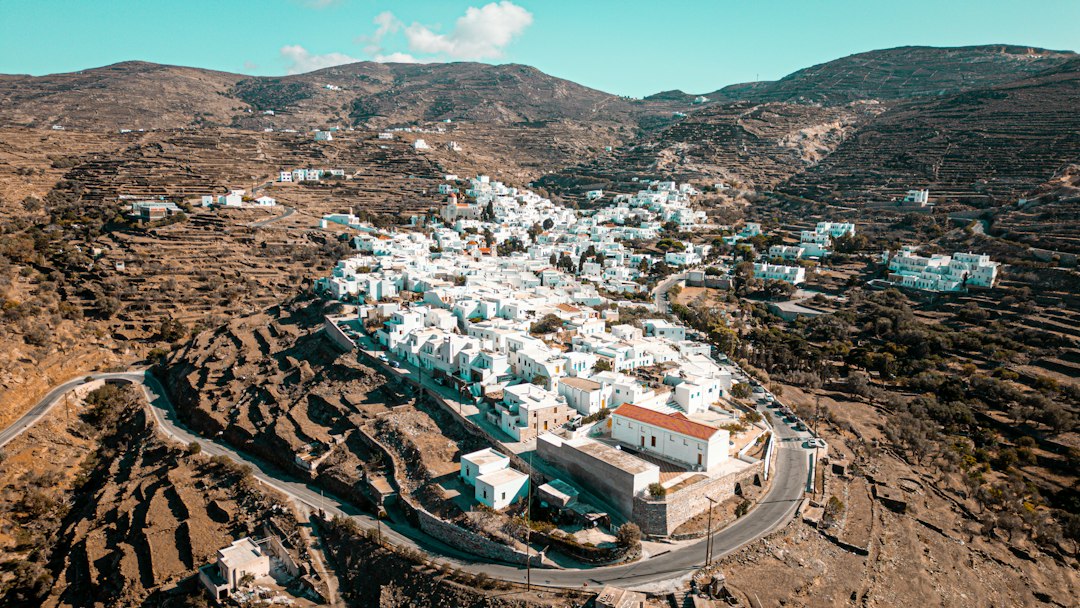
Tinos is a Cycladic island in the Aegean Sea covering 194 km² with a permanent population of 8,934 (2021 census), sitting at elevations up to 729 m on its mountainous interior. The island is one of the most important pilgrimage sites in the Orthodox Christian world, home to the Church of Panagia Evangelistria in Tinos Town, which draws hundreds of thousands of Greek and international visitors each year. Located roughly 25 nautical miles northeast of Mykonos and directly south of Andros, Tinos combines religious heritage, Venetian dovecotes, and marble-carving tradition with uncrowded beaches.
Three Things Not to Miss in Tinos
- Church of Panagia Evangelistria — Greece’s most venerated Orthodox pilgrimage church, housing a miraculous icon found in 1823 and drawing vast crowds on 15 August.
- Volax Village and the Marble Workshops — A boulder-strewn plateau village at roughly 400 m altitude, ringed by a landscape of giant granite rocks found nowhere else in the Cyclades.
- Kolymbithra Beach — A double-bay beach on the north coast offering both sheltered and wind-exposed swimming within a single 10-minute walk.
Scroll down for our complete travel guide with tips on getting there, where to stay, costs and more.
Ferries & Flights to Tinos
How do I get to Tinos — by flight or ferry?
Ferry is the primary and most practical route to Tinos. There is no airport on the island; all arrivals come by sea. The main departure ports are Piraeus (Athens’ main port) and Rafina, the latter being approximately 30 km northeast of Athens city centre and consistently faster. High-speed ferries from Rafina reach Tinos Port in roughly 2.5–3 hours; conventional ferries take around 4–5 hours. Tip: Rafina is closer to Athens International Airport than Piraeus is, making it the smarter connection point if you fly into Athens. Book ferry tickets via Ferryscanner or Greek Ferries operators such as SeaJets and Golden Star Ferries. Seats sell out in peak August weeks, so advance booking is essential.
Which port is the best starting point for Tinos?
Tinos Port (Tinos Town harbour) is the single entry point for all ferries. Every vessel docks directly at Tinos Town (also called Chora), placing you immediately within walking distance of the Church of Panagia Evangelistria, the main market street, and the majority of accommodation. There is no secondary port on the island. Worth knowing: the waterfront can become extremely congested during the 15 August Dormition feast, when pilgrims arrive on multiple simultaneous sailings. If you arrive on that date, expect queuing both on-board and dockside. For exploring the island’s north and west, you will need onward transport from Tinos Town, as the port is located on the southern coast.
How long does the ferry crossing to Tinos take?
Crossing time ranges from about 2.5 to 5 hours depending on the route and vessel type. From Rafina, high-speed catamarans operated by SeaJets cover the distance in approximately 2.5–3 hours. Conventional ferries from Piraeus take around 4.5–5 hours. From Mykonos, which is the closest neighbouring island at roughly 25 nautical miles southwest, short inter-island ferries take under 30 minutes and run frequently in summer. From Andros, the crossing to Tinos is approximately 1 hour. Tip: inter-island connections between Tinos, Mykonos, Syros, and Andros are served by multiple operators in summer, making Tinos easy to include in a multi-island itinerary without returning to Athens each time.
What does a ferry ticket to Tinos cost?
Economy ferry tickets from Piraeus or Rafina to Tinos cost approximately €25–€45 per person for a standard seat on conventional ferries. High-speed catamaran tickets (SeaJets, Golden Star) run roughly €50–€75 per person depending on the season and how early you book. Cabin berths on overnight services cost more, typically €70–€110. The short inter-island hop from Mykonos to Tinos can cost as little as €15–€25 in economy class. Prices rise by 20–30% in July and August. Worth knowing: vehicle transport adds a significant surcharge — bringing a small car from Piraeus costs roughly €100–€160 extra each way in peak season. Check current fares directly on Ferryscanner.com or operator sites, as prices shift frequently.
Are overnight ferries to Tinos worth it?
Overnight ferries are worth considering only from Piraeus, and primarily as a budget sleep-and-travel option. The Piraeus–Tinos route is served by conventional ferries that depart late evening and arrive early morning, saving you a night’s hotel cost. However, Tinos is not the final destination on most overnight routes — the vessel typically continues to Mykonos or Heraklion — so arrival times can be inconvenient (around 4–5 AM). A cabin berth costs roughly €70–€110 per person. Worth knowing: if you value sleep quality, book a cabin rather than an airline-style seat or deck passage. For travellers flying into Athens International Airport and connecting via Rafina, the daytime high-speed option is usually more comfortable and only slightly more expensive than an overnight economy ticket.
Moving Around Tinos
Do I need a rental car or scooter on Tinos?
Yes — a rental car or ATV is strongly recommended for exploring beyond Tinos Town. The island covers 194 km² and has more than 60 villages, many of them on steep inland roads that buses do not serve daily. A small rental car costs approximately €40–€70 per day in shoulder season; expect €70–€100 per day in August. Scooters and ATVs are available from €25–€45 per day but are not suitable for the island’s narrow, winding mountain roads without experience. Tip: book your vehicle before arrival in July–August — rental fleets on Tinos are smaller than on neighbouring Mykonos, where competition keeps supply higher. The roads to villages such as Pyrgos and Volax are paved but narrow, requiring careful driving.
Are there buses between towns on Tinos?
Yes, KTEL buses operate on Tinos, but the network is limited and infrequent outside summer. The main bus station is at Tinos Town harbour, directly next to the ferry dock. Routes connect Tinos Town with Panormos, Pyrgos, Isternia, and Kolymbithra beach, among other destinations. In July–August, departures on the main routes run 4–6 times daily; in spring and autumn, frequency drops to 1–2 per day or ceases entirely on minor routes. A typical bus fare is approximately €2–€4 per journey. Worth knowing: buses are not timed to inter-island ferry arrivals reliably, and the last departure from outlying villages can be as early as 3 PM. For maximum flexibility across Tinos’s 60-plus villages, a rental vehicle is a practical necessity.
What does a rental car cost on Tinos — and where do I hire one?
Expect to pay approximately €40–€70 per day for a small car in shoulder season, rising to €70–€100 in August. Local agencies operate directly at Tinos Town harbour, making collection straightforward after ferry arrival. Reputable local operators include Vidalis Rent a Car and Tinos Rent a Car, both based at the port. International brokers such as Discover Cars also aggregate local inventory. Tip: always confirm whether the quoted rate includes basic collision damage waiver — many local agencies on Greek islands charge this separately at around €10–€15 per day. Full insurance buydown is worth considering on Tinos given the narrow inland lanes. Unlike on Mykonos, where demand is extreme, Tinos agencies are rarely fully booked outside peak August weeks, but pre-booking online is still advisable.
Which parts of Tinos are accessible by public transport?
The main tourist corridor — Tinos Town, Pyrgos, Panormos, and Kolymbithra beach — is reachable by KTEL bus. From Tinos Town harbour, the bus to Pyrgos (the island’s marble-carving centre, roughly 26 km north) runs several times daily in summer and connects onward to Panormos Bay. The beaches of Agios Fokas and Porto near Tinos Town are within 3–5 km and accessible on foot or by taxi. Remote villages on the western and central mountains, including Volax, are not served by regular buses and require a car or organised tour. Worth knowing: taxis (easily found at the harbour) fill the gap but availability can be tight on arrival days when multiple ferries dock simultaneously. Agree on the fare before boarding, as not all taxis use meters.
Can I cycle around Tinos?
Cycling is possible on Tinos but demanding — the terrain is mountainous with significant elevation gain. The island’s highest point exceeds 700 m and most inland roads involve steep gradients. Road cycling on the quieter inland routes is appealing for fit cyclists, but the lack of a developed bike-hire network means bringing your own bike or renting an e-bike (available from select shops in Tinos Town for approximately €25–€40 per day) is the realistic option. The coastal flat route between Tinos Town and Agios Fokas beach (about 3 km) is manageable. Tip: the wind on Tinos is notably strong — the island is among the windiest in the Cyclades, which makes cycling into headwinds particularly tiring. A combination of bus and e-bike suits most visitors better than attempting a full island circuit by pedal power.
Choosing a Base on Tinos
Which town should I base myself in on Tinos?
Tinos Town (Chora) is the best base for the majority of visitors. It offers the widest range of accommodation, restaurants, and services, is directly at the ferry port, and places the Church of Panagia Evangelistria within a 5-minute walk. Tavernas, bakeries, and the morning market on Evangelistrias Street are all within easy reach. For a quieter alternative, Pyrgos in the north provides an atmospheric village base among marble workshops and is suited to travellers with a rental car who prefer to avoid Chora’s pilgrim-season crowds. Panormos Bay, near Pyrgos, suits beach-focused visitors seeking calmer surroundings. Worth knowing: accommodation in Tinos Town is noisier around the feast of 15 August when all-night religious processions fill the streets — consider staying in Pyrgos if that date falls within your trip.
What does accommodation cost per night on Tinos?
Expect to pay approximately €70–€120 per night for a comfortable double room in Tinos Town in shoulder season. Budget guesthouses and private rooms start around €50–€60 in June and September. In peak August, mid-range hotels in Chora rise to €130–€200 per night. The boutique hotel market in Pyrgos is smaller but comparable in price. Self-catering apartments across the island start around €80–€100 per night for two people in summer. Tinos is noticeably cheaper than neighbouring Mykonos, where equivalent rooms often cost 2–3 times more. Worth knowing: accommodation within walking distance of the church fills first in the religious pilgrimage period (especially 15 August and 25 March); rates on those specific dates can spike by 50–100% above normal seasonal prices.
Which area of Tinos suits which travel style?
Tinos Town suits first-time visitors, pilgrims, and those without a car. Everything from ferry connections to restaurants and the island’s main church is within walking distance. Pyrgos and Isternia suit culture-focused travellers interested in marble craft, traditional architecture, and the Museum of Marble Crafts — a legitimate design-quality museum. Panormos Bay appeals to families and beach-focused visitors wanting a quiet north-coast base. Agios Sostis beach, on the northeast coast, attracts windsurfers and kitesurfers given the island’s persistent meltemi winds in summer. Worth knowing: Tinos as a whole skews toward cultural and religious tourism rather than nightlife — travellers seeking clubs and bars will find Mykonos (under 30 minutes away by fast ferry) a far better fit, while Tinos rewards those who value authenticity and calm.
How far in advance do I need to book accommodation on Tinos?
Book at least 2–3 months ahead for July and August; 2–4 weeks suffices for June and September. The critical exception is the feast of Dormition of the Virgin (15 August), which is the single most important religious event in Greek Orthodoxy — accommodation within 5 km of the church fills completely 4–6 months in advance on that date. For the secondary feast of Annunciation (25 March), book at least 2 months ahead. Tinos has a smaller hotel inventory than neighbours Mykonos or Paros, meaning the island reaches capacity faster despite lower overall visitor numbers. Tip: if you find Tinos Town fully booked, search for rooms in Pyrgos or Isternia — these villages receive fewer last-minute pilgrims and often hold availability longer into the booking window.
Are there good apartments or villas with sea views on Tinos?
**Yes — self-catering apartments and villas with Aegean views are available on Tinos, though the stock is more limited than on Mykonos or Paros. The area around Tinos Town’s upper hillside and the coastal stretch toward Agios Fokas offers apartments with sea-facing terraces, typically priced at €90–€160 per night for two people in July. The northern coast near Panormos has a handful of villa rentals with open-water views toward Andros and the Turkish coast on clear days. Platforms such as Airbnb and Booking.com** list the majority of inventory. Tip: properties advertised as “sea view” in Greek island listings sometimes mean partial or distant views — request photos of the actual terrace before confirming. Villas sleeping 4–6 people represent better per-person value than hotel rooms in peak season.
When to Come to Tinos
When is the best time to visit Tinos?
June, September, and October offer the best balance of warm weather, manageable crowds, and lower prices. Based on climate analysis, the recommended travel window runs June through November. July and August are hot and very windy (meltemi), with August being the busiest month by far due to the 15 August religious feast. September brings temperatures still around 24–26°C, calm seas, and a marked drop in visitor numbers. October remains pleasant for walking and sightseeing, with occasional rain. Worth knowing: the 15 August feast is genuinely extraordinary as a cultural experience — if you want to witness tens of thousands of pilgrims on their knees on Megalocharis Street — but it requires advance planning for accommodation and ferries. Avoid it if you prefer quiet. Spring (April–May) is green and atmospheric but some beach businesses have not yet opened.
What is the weather like throughout the year on Tinos?
Tinos has a Mediterranean climate with hot, dry summers and mild, wetter winters. Summer temperatures in July–August typically reach 28–32°C during the day, cooled by strong meltemi northerly winds that are characteristic of the Cyclades — Tinos is among the windier islands in the group. This makes August feel comfortable for walking but can make beach days on north-facing beaches choppy. September and October average around 22–26°C with calmer conditions. Winter months (December–February) are mild by northern European standards at 10–15°C but bring periodic rain and rough seas that can disrupt ferry schedules. The island sits at up to 729 m altitude in its interior, meaning mountain villages such as Volax can feel significantly cooler than the coast even in summer.
When does Tinos get overcrowded?
The single most crowded period is the week surrounding 15 August, when Tinos receives the largest religious pilgrimage in Greece and normal island life is significantly disrupted. The rest of August is busy but manageable. July sees strong tourist arrivals, particularly from Greek domestic travellers. The harbour area of Tinos Town is always the focal point of congestion — restaurants, taxis, and the road leading to the church all become bottlenecked. Ferries from Mykonos deliver day-trippers who are on-island for only 4–6 hours, adding midday pressure to the waterfront. Tip: if you visit in peak season, explore interior villages such as Dio Choria, Falatados, or Tarambados in the morning hours when day-trippers are still arriving and the harbour is at its quietest.
Is there a worthwhile shoulder season on Tinos?
Yes — September and early October are genuinely excellent on Tinos. Seawater temperatures remain around 23–25°C through September, beaches are far quieter than in August, tavernas still operate full menus, and ferry connections from Piraeus and Rafina remain frequent. Accommodation prices drop by roughly 20–40% compared to August peak. The marble workshops and museums in Pyrgos operate on full schedules until at least late October. June is equally appealing for those who prefer mild heat without the meltemi’s full summer force. Worth knowing: some beach-focused businesses and boat rental operators on the northern coast close by mid-October, so September is the more reliably full-service month. By contrast, neighbouring Mykonos shuts down more abruptly after its club-driven season ends, making Tinos the stronger autumn destination of the two.
When does the beach and watersports season on Tinos begin?
The beach season on Tinos effectively runs from late May through early October, with peak watersports activity in July and August. Sea temperatures reach swimmable levels (around 20°C) by late May. The island’s strong meltemi winds, most consistent from July to mid-August, make Tinos a recognised destination for windsurfing and kitesurfing, particularly at Agios Sostis beach on the northeast coast. Operators such as Tinos Surf Lessons offer tuition and equipment hire. Kolymbithra on the north coast offers both a sheltered bay and a windier open bay side by side, suiting mixed groups. Tip: the meltemi can cancel or delay ferry services on rough days — if you plan watersports that depend on specific conditions, build flexibility into your schedule rather than booking a single fixed day in advance.
Costs on Tinos
What does a daily budget cost on Tinos?
A realistic daily budget for Tinos runs approximately €80–€130 per person including accommodation (shared double room), meals, and local transport. Budget breakdown: accommodation at roughly €35–€60 per person (half a mid-range double), two sit-down meals at approximately €15–€25 per person each, plus ferry connections and one or two coffees. A self-catering option with an apartment and supermarket shopping can bring costs closer to €55–€70 per day. Tinos is considerably cheaper than Mykonos, where equivalent spending would buy a noticeably lower standard. Worth knowing: the major budget variable is the rental car — at €40–€70 per day split between two people, it adds €20–€35 per person per day but is often the only practical way to reach the island’s most rewarding interior villages and northern beaches.
Is Tinos more expensive than the Greek mainland?
Tinos is moderately more expensive than the Greek mainland but significantly cheaper than the luxury Cycladic islands. A sit-down taverna lunch in Tinos Town costs roughly €12–€18 per person, compared to around €10–€14 in a mid-sized mainland city. The premium is largely driven by transport costs for goods arriving by ferry. Compared to Mykonos, prices on Tinos are roughly 30–50% lower across accommodation, food, and services. Compared to Santorini, Tinos is similarly positioned — more affordable and less commercialised. The island’s supermarkets in Tinos Town stock essentials at near-mainland prices. Worth knowing: waterfront restaurants in Tinos Town harbour charge a visible tourist premium — walking one street inland to Evangelistrias Street or side alleys typically cuts meal prices by 20–30% for comparable quality.
What expenses on Tinos are unavoidable?
The ferry ticket and ground transport are the two inescapable costs on Tinos. The return ferry from Piraeus or Rafina costs approximately €50–€150 per person depending on vessel type and season. Ground transport — either a rental car at €40–€100 per day or a combination of KTEL buses and taxis — is unavoidable if you want to see more than Tinos Town. Entry to most churches and chapels is free, including the Church of Panagia Evangelistria. The Museum of Marble Crafts in Pyrgos charges an admission of approximately €4–€6 (verify current price with the Piraeus Bank Cultural Foundation, which operates the museum). Tip: budget separately for a quality meal at a taverna in Pyrgos or Isternia — this is a genuine highlight of any Tinos visit and typically costs €20–€35 per person with wine.
What does food cost on Tinos — local versus tourist prices?
**A full meal at a local taverna costs approximately €14–€22 per person including wine or beer; waterfront tourist restaurants charge €20–€35. A Greek coffee in a kafeneion away from the harbour runs about €1.50–€2; the same coffee on the seafront promenade of Tinos Town costs €3–€4. Fresh local specialities worth ordering include loukoumades (honey doughnuts, around €3–€5 per portion), artichokes from Tinos (a genuine local product), and louza (cured pork, priced by weight at delis in Tinos Town). Tavernas in inland villages such as Kardiani or Isternia** typically price 15–25% lower than comparable spots in Tinos Town. Tip: the morning bakeries on the back streets of Tinos Town sell cheese pies and sesame rings for under €2 — these make an excellent and authentically priced breakfast.
What are the best beaches on Tinos?
Kolymbithra on the north coast and Agios Fokas near Tinos Town are the standout beaches. Kolymbithra is a double bay — one side sheltered and calm, the other open and wind-driven, both with clear turquoise water and a beach taverna. It sits roughly 25 km from Tinos Town and requires a car or bus to reach. Agios Fokas, about 3 km east of the port, is the most accessible organised beach with sun beds and a beach bar. Porto beach is a quieter alternative 5 km from Tinos Town. Agios Sostis, on the northeast coast, is a long sandy beach exposed to the meltemi and suited to windsurfers. Worth knowing: Tinos beaches are not as built up as those on Mykonos — most lack the polished infrastructure of its neighbour, which is exactly their appeal for travellers seeking a less commercialised atmosphere.
Beaches, Coves & Highlights of Tinos
What are the top sights on Tinos beyond the beaches?
**The Church of Panagia Evangelistria, the village of Pyrgos, and the dovecotes of the Tarambados valley are the cultural highlights. The Church of Panagia Evangelistria in Tinos Town houses the icon of the Virgin Mary discovered in 1823 and is among the most visited religious sites in Greece. Pyrgos, roughly 26 km north of Tinos Town, is a living marble-carving village with active workshops, the Museum of Marble Crafts, and the Museum of Tinian Artists. The Venetian dovecotes — whitewashed towers with geometric relief patterns — are scattered across the island’s valleys, most densely around Tarambados**, and represent a unique architectural form not found in comparable density anywhere else in the Cyclades. The village of Volax, surrounded by enormous rounded granite boulders, is a geologically surreal landscape worth the detour.
What watersports activities are available on Tinos?
Windsurfing, kitesurfing, paddleboarding, and snorkelling are the main watersports available on Tinos. The island’s consistent meltemi winds make it a recognised windsurfing destination, with Agios Sostis beach the primary centre. Equipment hire and tuition are available from local operators — check Tinos Surf Lessons (verify current operational status and pricing directly with them, as seasonal schedules vary). Paddleboard and kayak hire is available at Agios Fokas and Kolymbithra beaches in July–August, typically at €15–€25 per hour. Boat rental for self-guided coastal exploration is possible through the harbour in Tinos Town. Worth knowing: the meltemi blows strongest in the afternoon between July and mid-August — morning sessions are calmer and better suited to beginners, while afternoon conditions attract more experienced riders.
What is the culinary highlight of Tinos?
Tinos artichokes are the island’s most distinctive local product, cultivated in the fertile valleys and considered among the finest in Greece. They appear in dishes across the island from spring through early summer. Other local specialities include louza (a dry-cured pork fillet seasoned with spices and pepper, sold at delis in Tinos Town), volaki cheese (a firm local variety made from sheep and goat milk), and melekouni (a sesame and honey sweet associated with island celebrations). The village of Isternia and Pyrgos have tavernas with reputations for high-quality traditional cooking using these local ingredients. Tip: visit the morning market stalls along the harbour in Tinos Town early in the day for the freshest local produce, including seasonal artichokes and herbs, at lower prices than in tourist-facing shops.
Which parts of Tinos are still off the beaten track?
The western coast villages and the high mountain interior remain largely untouched by tourism. Villages such as Komi, Ktikados, Falatados, and Triantaros in the central highlands see very few non-Greek visitors. The western coast road between Isternia and Ormos Isternion passes through landscape with minimal tourist infrastructure. The Exomvourgo rock fortress, a Venetian-era stronghold at around 640 m altitude with views spanning to neighbouring islands on clear days, receives far fewer visitors than the marble workshops of Pyrgos despite being equally rewarding. Worth knowing: the island’s interior is genuinely rural — fuel up in Tinos Town before heading into the mountains, as petrol stations are sparse. Compared to the day-tripper circuit from Mykonos, which focuses almost entirely on Tinos Town and the church, a car-based inland exploration puts you effectively alone in the landscape.
How many days do I need on Tinos?
3 full days is the realistic minimum; 5–6 days allows a thorough exploration. A 3-day itinerary covers the Church of Panagia Evangelistria and Tinos Town, a day trip to Pyrgos and Panormos, and a beach day at Kolymbithra or Agios Fokas. Five to six days adds the inland mountain villages, the Exomvourgo fortress hike, the western coast, and unhurried time in artisan workshops. Tinos is frequently visited as a day trip from Mykonos (under 30 minutes by fast ferry), but this approach allows only 4–5 hours on-island and barely scratches the surface. Worth knowing: Tinos rewards slower travel more than most Cycladic islands — its appeal is cumulative rather than concentrated in two or three iconic spots, and travellers who spend fewer than 2 nights consistently report wishing they had stayed longer.
Tinos at a Glance
| Population | 8,934 |
|---|---|
| Currency | EUR (€) |
| Official language | Greek |
| Time zone | UTC+02:00 |
Source: Wikidata, retrieved October 2026.
Greece › Tinos
More Destinations in South Aegean Region
More Destinations in Greece
Essential Resources for Planning Your Trip to Tinos
- Tourism peaks on Tinos island — official visitor information
- Wikivoyage: Tinos — community travel guide & practical tips
- Wikipedia: Tinos — history, geography & background
- Tinos, Greece Tours & Activities — how to get there and around
Data Sources
Key facts on this page (population, currency, language, time zone) come from Wikidata, climate figures from Open-Meteo. The retrieval date is shown next to the facts table.