
Paros: The Complete Travel Guide (2026)
Last reviewed: October 2026 · key facts checked against Wikidata
Paros Weather by Month: When to Go
| Month | Day | Night | Sea | Rain days | Rain mm | Wind km/h | Good for |
|---|---|---|---|---|---|---|---|
| Jan | 11° | 7° | 17° | 11 | 70 | 29 | – |
| Feb | 11° | 7° | 16° | 7 | 43 | 28 | – |
| Mar | 12° | 8° | 17° | 8 | 41 | 27 | – |
| Apr | 15° | 10° | 17° | 3 | 21 | 24 | Hike |
| May | 19° | 13° | 19° | 3 | 11 | 22 | Hike |
| Jun | 24° | 18° | 22° | 1 | 4 | 22 | SwimHike |
| Jul | 26° | 20° | 24° | 0 | 1 | 27 | Swim |
| Aug | 26° | 21° | 26° | 1 | 2 | 26 | Swim |
| Sep | 23° | 18° | 25° | 2 | 8 | 24 | SwimHike |
| Oct | 19° | 15° | 23° | 3 | 19 | 23 | Hike |
| Nov | 16° | 12° | 21° | 6 | 44 | 25 | Hike |
| Dec | 12° | 9° | 19° | 11 | 73 | 27 | – |
Sources: ERA5 reanalysis via Open-Meteo, 2016–2025 (10-year average) for air temperature, rain and wind (average daily maximum); Open-Meteo Marine API, 2023–2025 for sea surface temperature. A rain day has at least 1 mm. Area averages; individual years vary.
Paros Travel Guide: Everything You Need to Know (2026)
Paros is a Cycladic island in the central Aegean Sea, situated approximately 150 km south-east of Piraeus and just 8 km west of Naxos, with a permanent population of 13,715 residents. The island covers 196 km² and sits at elevations reaching 724 m above sea level at its highest peak, Mount Profitis Ilias. Famous for millennia for its translucent Parian marble — used in the Venus de Milo and the Nike of Samothrace — Paros has evolved into one of the Cyclades’ most balanced destinations, blending authentic village life with well-developed tourism infrastructure.
Three Things Not to Miss in Paros
- Parikia Old Town & Panagia Ekatontapiliani — A Byzantine church complex founded in the 4th century AD, among the best-preserved early Christian monuments in the Aegean.
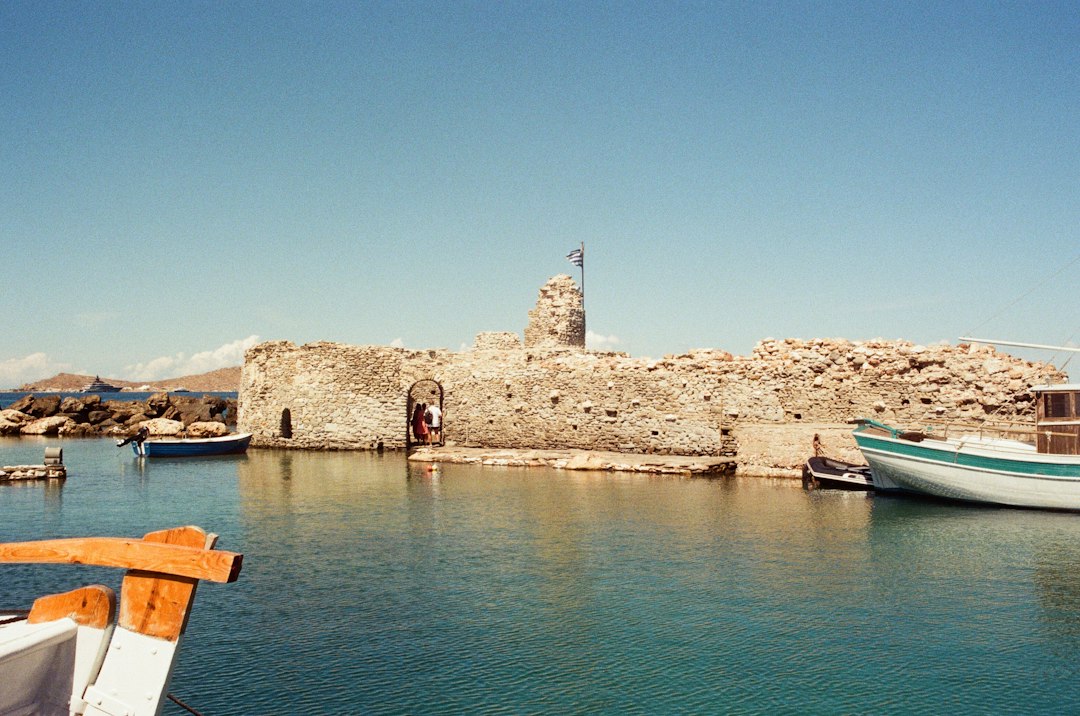
- Naoussa Harbour — A whitewashed fishing village whose half-submerged Venetian castle ruins sit directly at the water’s edge.
- Golden Beach (Chrysi Akti) — An 800-metre stretch of fine golden sand that hosts the annual PWA Windsurfing World Cup every August.
Scroll down for our complete travel guide with tips on getting there, where to stay, costs and more.
Getting to Paros: Ferry or Flight
How do I get to Paros — by flight or ferry?
Both options work well; the right choice depends on your origin and budget. Flights from Athens (Eleftherios Venizelos, ATH) to Paros National Airport (PAS) take about 45 minutes and are operated seasonally by Sky Express and Olympic Air — check their sites directly for current schedules, as service is limited outside summer. Ferries from Piraeus take between 3.5 hours (high-speed catamaran) and 5–6 hours (conventional ferry), operated by Blue Star Ferries and SeaJets. Tip: ferries run year-round, flights do not. Worth knowing: if you’re already on Naxos, the crossing to Paros is just 30–40 minutes by fast ferry, making a two-island itinerary very practical.
Which airport or port is the best starting point for Paros?
For most international travellers, Piraeus Port in Athens is the primary gateway — it offers the most ferry departures to Paros, with up to 6 sailings daily in high season. Paros National Airport (PAS) is located just 8 km south of Parikia, the capital, and handles direct charter flights from Northern Europe in summer plus domestic connections from Athens. Worth knowing: PAS has a short runway and cannot accommodate wide-body aircraft, so international travellers must connect via Athens (ATH) or Heraklion (HER). If you land in Athens, allow at least 3 hours between your international arrival and ferry boarding to clear customs and reach Piraeus.
How long does the ferry crossing to Paros take?
Crossing time varies significantly by vessel type. From Piraeus, a SeaJets or Golden Star Ferries high-speed catamaran reaches Parikia in approximately 3.5–4 hours; Blue Star Ferries’ conventional car ferries take 5–6 hours on the same route. From Naxos, the crossing is just 30–40 minutes by fast ferry. From Santorini, count on roughly 2 hours by high-speed service. Tip: book via Ferryhopper or directly with the operator for real-time schedules and pricing. Worth knowing: in strong meltemi winds — common in July and August — high-speed catamarans are more frequently cancelled than conventional ferries, so build schedule flexibility into your itinerary.
What does a flight or ferry to Paros cost?
Ferry prices from Piraeus start at roughly €20–30 per person (deck class, conventional ferry) and €50–70 for high-speed services; cabin berths on overnight-adjacent services add €15–30. Bringing a car adds approximately €70–90 each way on Blue Star Ferries — check bluestarferries.com for current rates. Domestic flights from Athens on Sky Express or Olympic Air range from about €60–130 one-way depending on season and booking lead time; verify directly on the airlines’ sites. Worth knowing: flight prices spike sharply in July and August when demand from Greek diaspora and Northern European charter traffic peaks — ferries remain the more budget-reliable option. All prices are estimates; confirm with operators before booking.
Are overnight ferries to Paros worth it?
Overnight ferries are not a standard Piraeus–Paros product because conventional sailings take only 5–6 hours, not long enough to justify a sleeping cabin. Blue Star Ferries does operate a late evening departure from Piraeus (typically around 22:00–23:00), arriving in Parikia in the early morning — this saves one night’s accommodation cost and maximises island time. Tip: book a Pullman reclining seat (about €5–10 above deck class) for comfort on the overnight run. Worth knowing: the vessel continues to other Cycladic islands, so noise and port stops around Syros may disturb sleep. For travellers based on Naxos, the 30-minute crossing makes an overnight crossing irrelevant.
Getting Around Paros
Do I need a rental car or scooter on Paros?
A rental vehicle is strongly recommended for exploring beyond Parikia and Naoussa. The island is 196 km², and scenic villages like Lefkes, Marpissa, and Aliki are poorly served by bus. Scooters (50cc) rent for approximately €25–40/day in high season; small cars for €40–70/day — confirm rates with local operators in Parikia or Naoussa such as Forget Me Not or Acropolis Rent a Car. Worth knowing: Paros roads are narrow and often shared with quad bikes and inexperienced renters — scooters require genuine riding experience. Tip: if you plan to stay exclusively in Parikia or Naoussa and take day trips by bus or boat, a car is optional, but you will miss inland villages and quieter beaches like Monastiri.
Are there buses between towns on Paros?
Yes — KTEL Paros operates a public bus network connecting the main settlements. The core routes link Parikia with Naoussa (approximately 20 minutes, about €2), Aliki, Pounta, and Golden Beach. Services run frequently in summer (every 30–60 minutes on the Parikia–Naoussa corridor) but drop to a few runs daily outside peak season (June–September). Tip: timetables are posted at the Parikia bus station near the port and on the KTEL Paros website — check for current schedules before relying on them. Worth knowing: buses do not serve inland Lefkes or more remote beaches like Monastiri directly, making them insufficient as a sole transport mode if you want to see the full island.
What does a rental car cost on Paros — and where do I hire one?
Small car hire in high season (July–August) runs approximately €50–70/day including basic insurance; a scooter costs €25–40/day. In shoulder months like June or September, rates drop by roughly 20–30%. Most rental agencies cluster around Parikia port and along the main road into Naoussa — operators include Acropolis Rent a Car and Paros Rent a Car (verify availability on their sites). Tip: book at least 2–3 weeks ahead for July/August visits, as quality vehicles sell out. Worth knowing: basic insurance typically excludes tyre and underbody damage — read the policy before signing. A full tank of petrol costs approximately €60–80 for a small car to fill from near-empty.
Which parts of Paros are accessible by public transport?
The Parikia–Naoussa corridor is well served by KTEL buses running roughly every 30 minutes in peak season. Aliki and Pounta (for the Antiparos ferry) are also on KTEL routes. Golden Beach and Santa Maria are accessible by bus in summer. However, the inland village of Lefkes (the medieval island capital), the beaches of Monastiri, Kolymbithres, and the southern coastal road are not adequately served. Worth knowing: Naoussa harbour runs seasonal boat excursions to beaches like Kolymbithres and Lageri — these are the most practical way to reach northern beaches without a car, at roughly €10–15 return per person. Confirm fares and schedules at Naoussa port.
Can I cycle around Paros?
Cycling is feasible on specific routes but challenging island-wide. The island’s highest point reaches 724 m, and interior roads to Lefkes involve steep ascents. However, the coastal road from Parikia towards Aliki, and the relatively flat northern route towards Naoussa, are manageable on a standard bicycle or e-bike. E-bike rentals are available in Parikia for approximately €20–35/day — enquire locally at port-area hire shops. Tip: the Paros Trail network (marked hiking and cycling paths) offers off-road routes; download the trail map from the Paros municipality website before you go. Worth knowing: summer heat regularly exceeds 30°C, making midday cycling uncomfortable — ride before 10:00 or after 17:00.
Where to Stay on Paros
Which town should I base myself in on Paros?
Parikia is the best all-round base: it has the main port (essential for island-hopping), the widest range of accommodation, and easy access to KTEL buses. Naoussa suits travellers seeking a more upscale, atmospheric atmosphere — its harbour restaurants and boutique hotels are excellent, but accommodation costs are 15–25% higher than Parikia. Aliki in the south is quieter and better for families. Worth knowing: Paros is compact enough (roughly 25 km coast to coast) that basing yourself in any main village and renting a scooter or car gives full island access. Compared to Naxos (8 km east), Paros has a livelier nightlife scene, while Naxos offers more dramatic mountain hiking.
What does accommodation cost per night on Paros?
Budget travellers can find economy rooms from approximately €100/night in peak season (Numbeo data); mid-range hotels and studios in Parikia or Naoussa typically cost €120–200/night in July–August. Boutique hotels with sea views in Naoussa push to €250–400/night. In shoulder season (May, October), rates drop by 30–50%. Worth knowing: most Paros accommodation does not include breakfast in the quoted rate — add roughly €8–15/person for a café breakfast near the port. Tip: self-catering studios with kitchenettes (widely available across the island) are cost-effective for families and typically 20–30% cheaper than hotel rooms of comparable quality.
Which area of Paros suits which travel style?
Parikia suits first-time visitors and island-hoppers who need port access, plus budget-conscious travellers using public buses. Naoussa is ideal for food lovers, honeymooners, and those seeking an upscale village atmosphere — it has the island’s best restaurant concentration. Golden Beach (Chrysi Akti) is the destination for windsurfers and watersports enthusiasts, hosting the annual PWA World Cup. Aliki appeals to families and those seeking quieter, shallow-water beaches. Lefkes, the medieval inland capital at roughly 260 m altitude, is perfect for walkers and travellers wanting an escape from coastal crowds. Worth knowing: Paros is significantly busier than neighbouring Antiparos (reachable in 10 minutes by ferry from Pounta), which remains the quieter alternative.
How far in advance should I book accommodation on Paros?
Book 3–4 months ahead for July and August travel — Paros is one of the most visited Cycladic islands, and quality accommodation in Naoussa sells out by April for peak weeks. For June or September, 4–6 weeks is usually adequate. Tip: accommodation directly booked through the property often unlocks a 5–10% discount versus OTA rates — phone or email directly after finding a listing on Booking.com. Worth knowing: Greek Easter week (dates shift annually) and the last week of August are the two most congested periods; ferries and hotels book out simultaneously. Flexible travellers benefit from booking September — prices are lower, the sea remains warm (around 24°C), and crowds thin noticeably.
Are there good apartments or villas with sea views on Paros?
Yes — Paros has a well-developed self-catering market. Studios and apartments with Aegean-facing terraces are particularly concentrated around Naoussa, Santa Maria, and the coastal road south of Parikia towards Livadia beach. Villas with private pools exist primarily around Naoussa and Marpissa, starting from approximately €250–400/night in high season for a 2-bedroom property — check Airbnb and local agency Paros Villas for listings. Tip: studios in Aliki and Logaras offer sea-adjacent positions at 20–30% less than equivalent Naoussa properties. Worth knowing: many sea-view properties on Paros are positioned on hillsides, meaning a sea view from the terrace does not equal beach-level access — check walking distance to water before booking.
Best Time to Visit Paros
When is the best time to visit Paros?
June, July, August, September, and October are the best travel months based on climate analysis. June and September offer the optimal balance: warm temperatures, a fully operational tourist infrastructure, and significantly fewer crowds than July–August. July and August bring the reliable Aegean summer but also the meltemi — a strong northerly wind that can disrupt ferry schedules and make exposed beaches uncomfortably windy. October remains pleasant for sightseeing and hiking, with the sea still warm enough for swimming. Worth knowing: outside May–October, many restaurants, beach bars, and rental agencies in Naoussa and beach areas close entirely — Paros has a defined seasonal rhythm unlike year-round destinations such as Crete.
What is the weather like on Paros throughout the year?
Paros has a classic Mediterranean climate with hot, dry summers and mild, wetter winters. Summer (June–August) brings consistent sunshine and temperatures regularly above 30°C in July–August, with the meltemi wind providing relief but also ferry disruptions. Autumn (September–October) is warm and increasingly calm, ideal for outdoor activities. Winter (November–March) is mild by Northern European standards but sees reduced services and occasional storms. Spring (April–May) is fresh with wildflowers but sea temperatures remain cool (around 17–19°C). Worth knowing: the meltemi is strongest in July and August, particularly on the north and east coasts — beaches like Kolymbithres on the northwest coast are more sheltered on windy days.
When does Paros get overcrowded?
Peak crowding occurs in the last two weeks of July and the first two weeks of August, when Greek domestic tourism combines with Northern European arrivals. The port area of Parikia and Naoussa harbour become noticeably congested; ferry queues can stretch over 1 hour for vehicle loading. Tip: if visiting in this window, book excursion boats to beaches like Kolymbithres from Naoussa early in the morning — boat trips sell out by midday. Worth knowing: Paros sees roughly 400,000+ tourists annually across its roughly 5-month season — a figure that dwarfs the permanent population of 13,715. Compared to Mykonos, Paros remains less saturated with ultra-luxury tourism but is no longer an undiscovered island.
Is there a worthwhile shoulder season on Paros?
September is the strongest shoulder season choice. Sea temperatures hover around 24°C, most restaurants and accommodation remain open, and tourist volumes drop noticeably after the Greek school return in early September. Prices for accommodation fall 20–35% compared to August peaks. June is the spring-side shoulder: infrastructure is fully operational, but crowds are lighter and temperatures are comfortable without excessive heat. Worth knowing: visiting in October is rewarding for hiking (Lefkes trails, Paros Trail network) but some beach bars and water-sports operators close after early October. Ferry frequencies also reduce from October onward — always check Blue Star Ferries schedules if island-hopping in shoulder season.
When does the beach and watersports season begin on Paros?
Beach season officially opens around mid-May, when beach bars at Pounda, Golden Beach, and Santa Maria set up operations and water temperatures reach approximately 19–20°C — cool but swimmable. Windsurfing and kitesurfing season at Golden Beach (Chrysi Akti) peaks from June through September, driven by the reliable meltemi winds. The PWA Windsurfing World Cup is held at Golden Beach each August. Scuba diving operators in Parikia typically open from May onward. Worth knowing: the sea around Paros is clearest and warmest in August–September (up to 26°C), making it the prime snorkelling window. Equipment rental at Golden Beach is well-organised — expect to pay approximately €30–60 for a windsurfing lesson.
What Paros Costs
What does a daily budget cost on Paros?
A realistic daily budget per person: budget traveller (dorm or basic studio, self-catering, bus transport) — approximately €60–80/day. Mid-range traveller (hotel room, two sit-down meals, scooter hire) — approximately €120–180/day. Comfort traveller (boutique hotel in Naoussa, restaurant dinners, day-boat excursion) — €250+/day. Reference prices from Numbeo: a cheap meal costs approximately €15, a mid-range dinner for two approximately €27, and an economy hotel approximately €100/night. Worth knowing: eating in Parikia’s back-street tavernas rather than Naoussa harbour-front restaurants cuts meal costs by roughly 30–40% without sacrificing quality.
Is Paros more expensive than the Greek mainland?
Yes — Paros runs approximately 20–40% more expensive than Athens for equivalent goods and services, primarily because most food, building materials, and consumables arrive by ferry, adding logistics costs. A local bus ride costs approximately €2, similar to Athens metro pricing, but restaurant meals and accommodation skew higher. Tip: supermarkets in Parikia (AB Vassilopoulos, Lidl) offer mainland-comparable prices for self-catering supplies. Worth knowing: compared to Mykonos (roughly 2 hours north by fast ferry), Paros is meaningfully more affordable — a taverna dinner in Parikia costs perhaps €25–35 for two, versus €60–100 for a similar meal in Mykonos. Santorini, 2 hours south, is similarly priced to Mykonos.
What expenses are unavoidable on Paros?
Three costs are effectively inescapable: ferry or flight transfers (€20–70 per leg depending on route and vessel type), local transport (scooter or car rental at €25–70/day is necessary for meaningful island exploration beyond two main towns), and accommodation (economy options start at approximately €100/night in season). Beach sunbed hire at organised beaches costs approximately €8–15 per sunbed — most popular beaches on Paros charge for this. Tip: free sunbed-free zones exist at Monastiri beach and parts of Faragas — arrive early to claim a spot. Worth knowing: Paros port tax is included in ferry tickets; there is no separate tourist tax levied directly on visitors beyond hotel accommodation taxes (typically €0.50–4/night depending on hotel category).
What does food cost on Paros — local versus tourist prices?
A cheap meal at a local taverna costs approximately €15 per person (Numbeo data); a mid-range restaurant dinner for two runs approximately €27. Naoussa harbour-front restaurants charge a visible premium — expect €18–25 per main course at the most photogenic spots. In Parikia’s inland streets and in village kafeneions in Lefkes or Marpissa, traditional dishes like fresh grilled octopus or moussaka cost €10–14. A Greek coffee (frappe or freddo espresso) costs approximately €2–3 everywhere. Tip: the daily fish catch at Naoussa is priced by weight — ask the price per kilo before ordering to avoid bill surprises. Supermarket self-catering dramatically reduces food costs for budget travellers.
What are the best beaches on Paros?
Golden Beach (Chrysi Akti) is the windsurf capital — 800 metres of fine sand on the east coast, organised with tavernas and sports operators. Kolymbithres, north of Naoussa, is famous for its sculpted granite rock formations and calm, turquoise water — accessible by boat from Naoussa in roughly 15 minutes. Santa Maria north of Naoussa suits families with shallow, clear water. Monastiri, near the airport, is a sheltered, partially tree-fringed beach popular with locals. Logaras and Piso Livadi on the east coast are calmer alternatives with tavernas. Worth knowing: west-coast beaches like Livadia (walking distance from Parikia) catch afternoon sun best but are more exposed to the meltemi in peak summer.
Beaches & Experiences on Paros
What top sights on Paros go beyond the beaches?
Panagia Ekatontapiliani in Parikia is a 4th-century Byzantine church complex — one of the oldest continuously used churches in Greece — and entry is free. Lefkes, the medieval inland capital, is a well-preserved marble-paved village at approximately 260 m elevation, connected by the Byzantine Road hiking path from Prodromos. The Paros Archaeological Museum in Parikia houses the Parian Chronicle (a marble inscription recording Greek history from 1582 BC) — admission is approximately €3. The Valley of the Butterflies (Petaloudes) near Psychopiana hosts thousands of Jersey tiger moths from June to September. Worth knowing: the Venetian Kastro in Parikia, built partly from ancient marble fragments, can be explored freely and offers panoramic sunset views over the port.
What watersports activities are available on Paros?
Paros offers one of Greece’s strongest watersports scenes. Windsurfing and kitesurfing at Golden Beach are world-class — the annual PWA World Cup confirms its international standing. Operators including Neilson and F2 Windsurf Center offer lessons from approximately €50–70 for a 1-hour session. Scuba diving is offered by Paros Diving Center in Parikia, with intro dives for approximately €50–60. Sea kayaking, paddleboarding, and boat rental are available at multiple beaches. Boat excursions from Naoussa port visit sea caves and remote beaches for roughly €25–40/person for a half-day trip. Worth knowing: the meltemi makes conditions at Golden Beach technically challenging in July–August — beginners should consider June or September for lessons.
What is the culinary highlight of Paros?
Fresh seafood is the defining culinary experience — grilled octopus, sea bream, and red mullet landed daily by the Naoussa fishing fleet. Gouna (sun-dried mackerel) is a Parian speciality found almost exclusively on the island — try it grilled at a Naoussa taverna. Local Parian wine (mainly Monemvasia and Mandilaria grapes) is produced by small estates near Lefkes and worth seeking out at wine shops in Parikia. Tzatziki and taramosalata made with local dairy (Paros has a strong cheese tradition — Arseniko is a local aged cheese) are excellent mezze options. Tip: the morning fish market near Naoussa harbour is an excellent early-visit; local catches are sold directly from boats between approximately 07:00–09:00.
Which parts of Paros are still off the beaten track?
The inland route between Lefkes and Marpissa via the Byzantine Road (an old marble-paved donkey path, approximately 4 km walk) sees a fraction of the visitors that beach areas attract. Monastiri beach, sheltered beneath the rocky headland near the airport, remains calmer than Golden Beach and Kolymbithres. The southern village of Aliki and its surrounding coastline are quieter than the north. For true solitude, the adjacent island of Antiparos (reached in 10 minutes by car ferry from Pounta, or 25 minutes by excursion boat from Parikia) is dramatically less developed — its cave at 85 m depth is one of Europe’s largest stalactite caves. Worth knowing: northern beach Faragas and Glyfas in the south are preferred by locals over tourist-heavy spots.
How many days do I need on Paros?
4–5 days is the ideal stay for a thorough first visit. Day 1–2: explore Parikia (Ekatontapiliani, Kastro, Archaeological Museum) and the nearby beaches. Day 3: base in Naoussa, take a morning boat to Kolymbithres, and walk back along the coastal path. Day 4: rent a scooter and drive the inland route through Lefkes and down to Golden Beach. Day 5: day trip to Antiparos (10-minute ferry from Pounta). Worth knowing: Paros works excellently as a hub for the central Cyclades — Naxos is 30–40 minutes away by fast ferry and offers superior mountain hiking and larger beaches, while Mykonos is roughly 1.5 hours north for those wanting a contrast in atmosphere and nightlife. A 7-day base on Paros with day trips to both is a well-tested itinerary.
Paros at a Glance
| Population | 13,715 |
|---|---|
| Currency | EUR (€) |
| Official language | Greek |
| Time zone | UTC+02:00 |
Source: Wikidata, retrieved October 2026.
Greece › Paros
More Destinations in South Aegean Region
More Destinations in Greece
Essential Resources for Planning Your Trip to Paros
- Wikivoyage: Paros — community travel guide & practical tips
- Wikipedia: Paros — history, geography & background
- What are the best and most cost-effective airport transfer … — how to get there and around
- Paros Park | Greece | Attractions — itineraries & inspiration
Data Sources
Key facts on this page (population, currency, language, time zone) come from Wikidata, climate figures from Open-Meteo. The retrieval date is shown next to the facts table.