
Syros: The Complete Travel Guide (2026)
Last reviewed: October 2026 · key facts checked against Wikidata
Syros Weather by Month: When to Go
| Month | Day | Night | Sea | Rain days | Rain mm | Wind km/h | Good for |
|---|---|---|---|---|---|---|---|
| Jan | 14° | 10° | 16° | 12 | 86 | 31 | – |
| Feb | 14° | 11° | 16° | 8 | 47 | 30 | – |
| Mar | 16° | 12° | 16° | 8 | 46 | 28 | Hike |
| Apr | 18° | 14° | 17° | 5 | 26 | 25 | Hike |
| May | 22° | 17° | 19° | 3 | 14 | 24 | Hike |
| Jun | 26° | 22° | 22° | 1 | 5 | 25 | Swim |
| Jul | 28° | 24° | 25° | 1 | 4 | 30 | Swim |
| Aug | 28° | 24° | 26° | 1 | 3 | 31 | Swim |
| Sep | 26° | 22° | 25° | 1 | 8 | 28 | Swim |
| Oct | 22° | 19° | 23° | 4 | 26 | 26 | Hike |
| Nov | 19° | 15° | 20° | 7 | 53 | 28 | Hike |
| Dec | 16° | 12° | 18° | 11 | 81 | 29 | – |
Sources: ERA5 reanalysis via Open-Meteo, 2016–2025 (10-year average) for air temperature, rain and wind (average daily maximum); Open-Meteo Marine API, 2023–2025 for sea surface temperature. A rain day has at least 1 mm. Area averages; individual years vary.
Syros Travel Guide: Everything You Need to Know (2026)
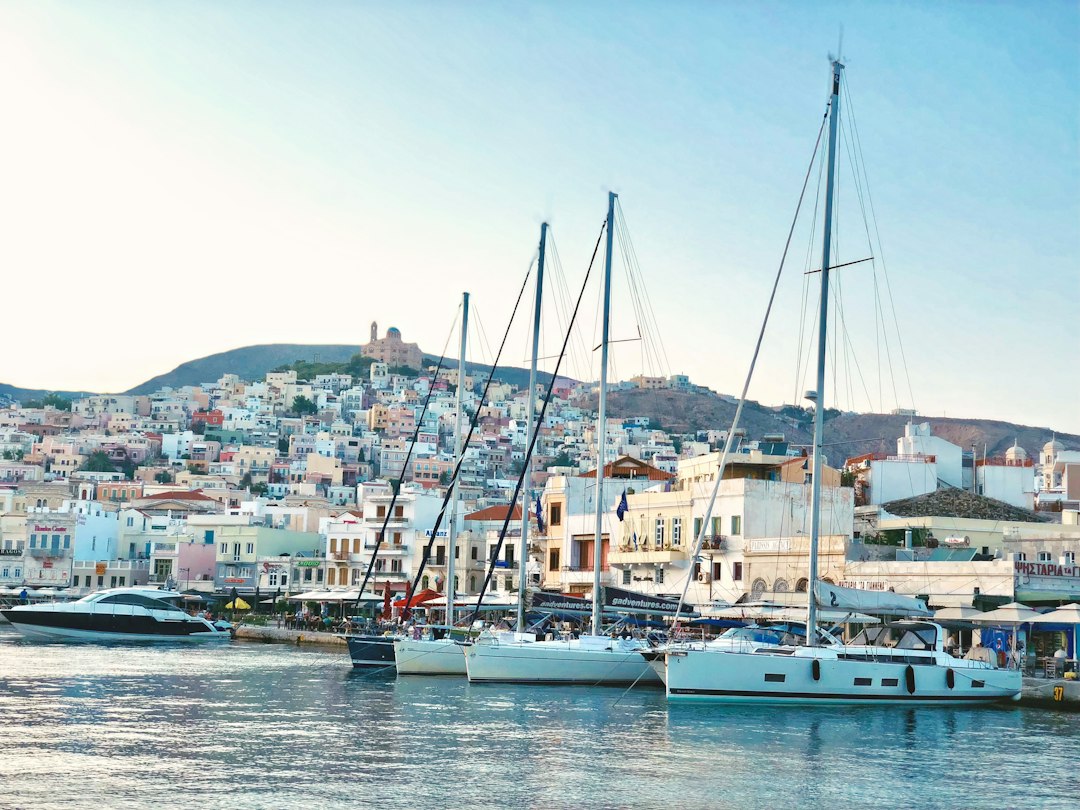
Syros is the administrative capital of the Cyclades, home to 21,124 residents and sitting 78 nautical miles (144 km) south-east of Athens at a maximum elevation of 442 metres above sea level. Unlike most Cycladic islands, Syros thrives year-round as a working Greek town rather than a purely seasonal resort, with the neoclassical port city of Ermoupoli serving as both the island’s commercial hub and the official capital of the entire Cyclades region. The island covers 83.6 km² and is best known for its striking blend of Catholic and Orthodox architecture, its loukoumades (honey puffs) and its revered local loukoumi (Greek delight).
Three Things Not to Miss in Syros
- Ermoupoli Waterfront and Apollo Theatre — The grand neoclassical port capital hosts a working replica of La Scala, Milan — seating around 300 — still staging opera and concerts.
- Ano Syros — A medieval Catholic hilltop settlement of whitewashed alleys rising to 139 metres, offering panoramic views over the entire Cyclades.
- Kini and Galissas Beaches — Kini bay faces west, delivering some of the Aegean’s most photographed sunsets just 8 km from Ermoupoli by road.
Scroll down for our complete travel guide with tips on getting there, where to stay, costs and more.
Getting to Syros: Ferry or Flight
How do I get to Syros — by flight or ferry?
Ferry from Piraeus is the primary route and takes approximately 4 hours on conventional ferries or around 2 hours 20 minutes on high-speed vessels. Syros also has a small airport, Syros National Airport (JSY), with seasonal and domestic flights operated by Sky Express and Olympic Air from Athens International Airport (ATH), a flight of roughly 45 minutes. Worth knowing: ferry frequency is high in summer (multiple daily departures from Piraeus), but drops to 1–2 sailings per day in winter. Flights are limited and often book out quickly in July and August. We recommend checking Hellenic Seaways and Golden Star Ferries timetables at ferries.gr alongside Sky Express for the most current schedules.
Which airport or port is the best starting point for Syros?
Piraeus Port (Athens) is the most practical starting point for the vast majority of visitors. The port is directly connected to Athens city centre via Metro Line 1 (about 25 minutes from Monastiraki). If flying in, Athens International Airport Eleftherios Venizelos (ATH) is your arrival hub, from which you take the Metro to Piraeus — total transfer around 60 minutes. Syros National Airport (JSY) is an alternative if you are connecting from Thessaloniki or Athens domestically, and it sits only 3 km from Ermoupoli — a taxi costs about €8–€10. Caveat: JSY has a short runway and limited capacity; flights cancel more readily in bad weather than ferry sailings do.
How long does the ferry crossing to Syros take?
From Piraeus: 4 hours on conventional ferry, about 2 hours 20 minutes on high-speed catamaran. Golden Star Ferries and Hellenic Seaways operate both vessel types. From Rafina port (closer to Athens airport), travel time is similar — roughly 3.5–4 hours on conventional services. Syros is also a stop on inter-Cycladic routes, so ferries connect it to Mykonos (about 1 hour), Naxos (about 2.5 hours) and Santorini (about 4–5 hours), making it an excellent hub for island-hopping. Worth knowing: seats and cabins on night sailings fill quickly in peak season — book through ferryscanner.com or directferries.com well in advance rather than at the dock.
What does a ferry or flight to Syros cost?
A conventional ferry from Piraeus costs roughly €20–€35 for a deck seat; high-speed tickets run €45–€65. Cabin upgrades on overnight routes add €25–€50 per person. Domestic flights from Athens on Sky Express or Olympic Air start around €40–€90 one way depending on season and how far in advance you book — check directly at skyexpress.gr or olympicair.com for live fares. Tip: booking ferry tickets 4–6 weeks ahead in July and August saves money and guarantees a seat; last-minute high-speed tickets can exceed €80. Travelling mid-week is consistently cheaper than Friday or Sunday crossings during summer peak.
Are overnight ferries to Syros worth it?
Overnight ferries to Syros are worth it only if you prioritise saving on accommodation. The crossing from Piraeus is only 4 hours at most on conventional vessels, so most departures are daytime or early evening arrivals — you will rarely need a full overnight cabin for this route alone. However, if you are island-hopping from further afield (e.g., Heraklion, Crete), overnight connections via Piraeus with a cabin can be practical. Cabins cost roughly €25–€50 extra per person. Trade-off: sleep quality on ferries varies significantly; budget cabins are functional but not comfortable by hotel standards. We recommend daytime high-speed crossings for most travellers visiting Syros specifically.
Getting Around Syros
Do I need a rental car or scooter on Syros?
A rental car or scooter is not essential but significantly expands your options. Ermoupoli, Ano Syros and nearby villages are walkable or reachable by local bus (KTEL Syros), and a taxi network covers the island. However, beaches like Megas Gialos, Vari and Foinikas on the southern coast are awkward to reach by bus outside peak hours. A small rental car costs roughly €35–€60 per day in high season; scooters start around €20–€30. Tip: hire from agencies on the Ermoupoli waterfront (Vaporia area has several) and confirm whether insurance covers off-road tracks, as some northern beach routes are unpaved. Roads are generally in good condition but narrow in the interior.
Are there bus connections between towns on Syros?
Yes — KTEL Syros operates a public bus network from Ermoupoli to the main towns and beaches. Key routes include Ermoupoli–Galissas, Ermoupoli–Vari, and Ermoupoli–Kini, with fares around €1.80–€2.50 per journey. Buses run roughly every 1–2 hours in summer and reduce to a skeleton service in winter. The main bus terminal is on the waterfront next to the ferry port, making connections straightforward on arrival. Caveat: schedules are not always synchronised with ferry arrivals, so an evening ferry landing may mean waiting 30–45 minutes for the next bus. We recommend downloading the KTEL Syros timetable PDF from their official site or checking at the terminal booth on arrival.
What does a rental car cost on Syros — and where do I hire one?
**Expect to pay roughly €35–€60 per day for a small car in high season (July–August); rates drop to €25–€40 in shoulder months. International chains like Hertz and Budget are not the norm here — hire from local agencies concentrated on the Ermoupoli waterfront and around Miaouli Square**. Agencies such as Enjoy Syros and Moto-Art Syros are frequently cited by visitors. Tip: always clarify whether the quoted price includes collision damage waiver and third-party liability — basic insurance is legally mandatory in Greece but excess levels vary. Booking online 2–3 weeks ahead in summer secures better rates and vehicle availability; walk-in hire is unreliable in August.
Which parts of Syros are accessible by public transport?
Ermoupoli, Ano Syros, Galissas, Vari, Kini and Foinikas are all reachable by KTEL bus. The network covers the main coastal villages and beaches on the western and southern coasts adequately in summer. However, northern Syros — including the village of Syringas and remote coves near Grammata Bay — has no regular bus service and requires a car, scooter or organised excursion boat. Taxis from Ermoupoli to most destinations cost €8–€20 depending on distance. Worth knowing: the taxi rank is on the main port square; WhatsApp-based booking with local drivers is common and we recommend asking your accommodation to arrange this in advance for early morning ferry connections.
Can I cycle around Syros?
Cycling around the entire island is challenging due to significant elevation changes — the interior rises to 442 metres. Recreational cycling is enjoyable on the flatter southern coastal roads between Foinikas, Poseidonia and Vari, a loop of roughly 10–12 km. The climb from Ermoupoli up to Ano Syros (139 metres elevation gain in under 2 km) is strenuous on a standard bike. E-bikes are available to hire in Ermoupoli for around €25–€35 per day, making hillier routes more manageable. Compared to flat Cycladic islands like Paros, Syros is considerably more demanding for cyclists. Tip: ride early morning in summer to avoid heat; roads are narrow and lack dedicated cycle lanes, so traffic awareness is essential.
Where to Stay on Syros
Which town on Syros should I base myself in?
Base yourself in Ermoupoli for the best access to transport, restaurants and cultural sights. As the island capital and Cyclades administrative centre, it has the widest accommodation range, direct ferry connections and a lively year-round atmosphere. The Vaporia neighbourhood — a cluster of 19th-century sea captains’ mansions above the water — is the most atmospheric sub-district for a stay. Alternatively, Galissas (8 km west) suits beach-focused travellers and families, with a sandy cove and a calmer pace. Avoid basing yourself in Vari or Foinikas if you rely on public transport, as evening buses are infrequent. Compared to staying on neighbouring Mykonos (1 hour by ferry), Ermoupoli offers significantly more authentic daily Greek life at lower prices.
What does accommodation cost per night on Syros?
**Budget guesthouses start at €40–€60 per night; mid-range hotels in Ermoupoli average €80–€140; boutique hotels in Vaporia charge €150–€250. Self-catering apartments — popular with families — run €70–€120 per night for a two-bedroom unit in July. Compared to Mykonos** (where comparable mid-range rooms exceed €200 in peak season), Syros represents clear value. Worth knowing: prices spike by 30–50% in the last two weeks of July and throughout August, when Ermoupoli also hosts the Apokries carnival (one of Greece’s largest). Always confirm whether breakfast is included — many Syros guesthouses quote room-only rates. Check Booking.com and direct hotel websites, as direct booking sometimes yields a 5–10% discount.
Which area of Syros suits which travel style?
**Ermoupoli suits culture seekers and those who want urban energy; Galissas and Kini suit beach lovers; Ano Syros suits architecture and photography enthusiasts. Families with young children find the flat sandy beach at Galissas safest and most practical, with tavernas directly on the shore. Couples seeking romance gravitate to Vaporia in Ermoupoli for sunset cocktails above the Aegean. Active travellers use Foinikas** as a base for kitesurfing on the southern coast, where consistent winds make conditions reliable. Budget backpackers tend to cluster around Ermoupoli’s port district, where cheaper rooms and supermarkets are within walking distance. Syros has no mass-market resort strip comparable to Ios or Faliraki, which suits travellers who prefer an unfiltered Greek island atmosphere.
How far in advance do I need to book accommodation on Syros?
Book at least 6–8 weeks ahead for July and August; 2–3 weeks is usually sufficient for June, September and October. Syros is not as internationally saturated as Santorini or Mykonos, but domestic Greek tourism is intense in August, and Ermoupoli fills quickly during the Apokries carnival period (dates vary — check Greek Orthodox calendar for 2026). Boutique properties in the Vaporia neighbourhood have fewer than 10 rooms each and sell out months ahead in summer. Worth knowing: cancellation policies on small family-run guesthouses are often stricter than on large hotels — read terms carefully before booking, particularly for stays during August. We recommend booking the ferry simultaneously with accommodation, as both fill on the same high-demand dates.
Are there good apartments or villas with sea views on Syros?
Yes — sea-view apartments and villas are available and represent good value compared to equivalent Cycladic islands. The Vaporia district in Ermoupoli has converted 19th-century mansions offering Aegean-view terraces; rates start around €120–€180 per night for a self-contained apartment. Airbnb and local rental platforms list properties in Ano Syros with panoramic hillside views from roughly €80–€130 per night. Villas with private pools are rarer on Syros than on Paros or Naxos — the island’s urban character means pooled accommodation requires advance searching. Tip: contact the Syros Hotel Owners Association or search on local Greek platforms like Greeka.com for independently managed properties not always listed on international booking sites.
Best Time to Visit Syros
When is the best time to visit Syros?
June, July, August, September and October are the best months to visit Syros, based on climate data. June and September offer warm, dry weather without August’s crowds and with lower accommodation prices. July and August are the hottest and busiest, with daytime temperatures typically exceeding 30°C and the Ermoupoli waterfront buzzing with activity. October remains pleasant for walking and sightseeing, with seas warm enough for swimming. Syros has a distinct advantage over purely seasonal Cycladic islands: it functions as a real town year-round, so even November to April offers open restaurants, museums and cultural events — though beach activity essentially ceases. We recommend late June or September as the optimal balance of weather, price and crowd levels.
What is the weather like on Syros throughout the year?
Syros has a typical Cycladic Mediterranean climate: hot, dry summers and mild, wetter winters. Summer months (June–August) are reliably sunny with very low rainfall; the Meltemi wind — a strong northern Aegean wind — blows regularly in July and August, cooling temperatures but occasionally disrupting ferry schedules. Autumn (September–October) brings occasional short rain showers but remains warm. Winter (December–February) is mild by northern European standards but can be grey and wet, with temperatures hovering around 12–15°C. Spring (March–May) is green and increasingly warm. Worth knowing: the island sits at 442 metres at its highest point — the interior and Ano Syros can be noticeably cooler and windier than the coast, so pack a layer even in summer evenings.
When does Syros get overcrowded, and how bad is it?
August is the busiest month, particularly during the first two weeks when Greek domestic holidaymakers dominate. Ermoupoli’s harbour tavernas and Miaouli Square fill to capacity on summer evenings; ferry queues grow long and popular beaches like Galissas become crowded by midday. However, Syros never reaches the extreme congestion of Santorini (which received over 3 million visitors per year pre-pandemic) — the absence of a major international airport keeps crowd levels more manageable. The Apokries carnival (typically February–March) is a separate peak for domestic visitors. Tip: arrive on Syros on a Tuesday or Wednesday rather than a Friday or Saturday in August to find noticeably calmer conditions on arrival day.
Is there a worthwhile shoulder season on Syros?
Yes — June and September are excellent shoulder months with warm weather, lower prices and open facilities. In June, sea temperatures reach around 23–24°C, accommodation costs 20–30% less than August peak, and the island’s restaurants and museums are fully operational. September is arguably the best month overall: crowds thin after the first week, the sea is at its warmest (around 25°C), and cultural events continue. October is viable for cultural tourism and hiking but swimming conditions become variable. Compared to Mykonos (which essentially shuts down culturally after September), Syros retains authentic local life well into October and partially through winter — a genuine advantage for independent travellers.
When does the beach and watersports season on Syros begin?
The beach season effectively runs from late May through October, with watersports operations opening fully by mid-June. Sea temperatures reach swimmable levels (around 22°C) by late May at Galissas and Kini. Kitesurfing and windsurfing at Foinikas on the southern coast benefit from the Meltemi wind that arrives reliably from late June through August. Watersports rental operators (paddleboards, kayaks, pedalos) typically open by early June and close by mid-October. Worth knowing: the Meltemi wind that makes Foinikas excellent for kitesurfing can make northern-facing beaches like Delfini choppy and less enjoyable in July–August — check wind forecasts on Windy.com before choosing your beach day.
What Syros Costs
What does a daily budget cost on Syros?
A realistic daily budget on Syros runs €60–€90 per person for a mid-range experience. This breaks down as: accommodation €40–€70 (mid-range, shared cost), meals €15–€25 (two sit-down meals at local tavernas), transport €5–€10 (bus or scooter share), and entrance fees/activities €5–€10. A tight backpacker budget relying on supermarket meals, hostel dorms and buses can reach as low as €40–€50 per day. A comfortable boutique hotel stay with restaurant dinners and a rental car pushes costs to €150–€200 per person per day in August. Syros is noticeably cheaper than Mykonos or Santorini for equivalent experiences — a restaurant meal that costs €30 per head in Mykonos typically costs €18–€22 in Ermoupoli.
Is Syros more expensive than the Greek mainland?
Syros is moderately more expensive than mainland Greek cities like Athens or Thessaloniki, primarily due to island logistics and seasonal demand. A coffee in Ermoupoli costs roughly €2–€3; a taverna meal with a carafe of wine runs €18–€28 per person. Supermarket prices are 10–20% higher than mainland equivalents because most goods are transported by ferry. However, compared to Mykonos (where a cocktail costs €16–€20 and a beach club sunbed €30–€50), Syros is significantly more affordable. Worth knowing: eating one meal per day at a local ouzeri (meze bar) rather than a waterfront tourist taverna cuts your food budget by 25–30% without sacrificing quality.
What expenses are unavoidable on Syros?
Ferry tickets, accommodation and eating out are the three non-negotiable costs. Ferry tickets from Piraeus start at €20–€35 each way for deck class — this is fixed regardless of travel style. If you hire a scooter or car (near-essential for exploring beyond Ermoupoli), add €20–€60 per day. Sunbed hire on organised beaches like Galissas runs €8–€15 per pair per day — avoidable by choosing free unorganised sections of the beach. Museum entry is modest: the Industrial Museum of Ermoupoli charges around €4 and the Archaeological Museum roughly €3 (verify current rates at the sites). Tip: tap water in Ermoupoli is generally safe to drink — avoiding bottled water saves a small but consistent daily expense.
What does food cost on Syros — local versus tourist prices?
A full meal at a local taverna costs €12–€18 per person; tourist-facing waterfront restaurants charge €22–€35. The divide is easy to navigate: the Vaporia and Maouna districts of Ermoupoli host authentic ouzeries where meze plates cost €4–€8 each and local ouzo or wine by the carafe runs €5–€8. A gyros pita from a street kiosk costs roughly €3–€4. Syros is particularly known for loukoumi (Greek delight) from shops like Kalokerinos — a box costs about €8–€15 depending on size and makes a high-quality, low-cost souvenir. Breakfast at a café (coffee plus a tiropita cheese pie) costs around €4–€6. Caveat: lobster pasta and fresh fish at harbour restaurants can spike to €35–€50 per person — always check prices before sitting down.
What are the best beaches on Syros?
Galissas, Kini, Vari and Foinikas are the top beaches, each with a distinct character. Galissas (8 km from Ermoupoli) is the largest sandy beach, with sunbeds, tavernas and calm, shallow water — best for families. Kini (7 km from Ermoupoli) faces west and is the prime sunset-watching beach, with a small fishing harbour and excellent fresh fish tavernas. Vari in the south has a sheltered bay popular with yachts and offers some of the island’s calmest water. Foinikas suits watersports enthusiasts due to reliable southern winds. For quieter options, the small cove at Delfini (accessible by dirt track north of Kini) requires effort to reach but rewards with near-solitude outside August.
Beaches & Experiences on Syros
Top sights beyond the beaches on Syros?
The Apollo Theatre, Miaouli Square, Ano Syros and the Vaporia district are the essential non-beach sights. The Apollo Theatre (Apollon Theatre) in Ermoupoli is a functioning neo-classical opera house — check the programme at apollontheatre.gr for 2026 performances. Miaouli Square, one of Greece’s grandest neoclassical town squares, is lined with marble and anchored by the impressive Town Hall designed by Ernst Ziller. Ano Syros — the medieval Catholic hilltop settlement — takes about 45 minutes to walk up from the port and rewards with extraordinary Cycladic views. The Industrial Museum of Ermoupoli (Pireos & Epicheirimaton Foundation) documents the island’s 19th-century shipbuilding heritage. Entrance to most sites costs €2–€5.
What watersports activities are available on Syros?
Kitesurfing, windsurfing, paddleboarding, kayaking and sailing are all available on Syros. The southern coast around Foinikas and Megas Gialos is the kitesurfing hub, with consistent Meltemi winds from late June through August. Operators offering lessons and equipment hire are based in Foinikas; beginner kitesurfing courses run approximately €200–€250 for a 3-day introductory course (verify with local operators). Paddleboard and kayak hire at Galissas and Kini costs roughly €10–€15 per hour. Sailing charter operators based in Ermoupoli port offer day trips to neighbouring Gyaros, an uninhabited island 13 km north-west of Syros visible from the coast. Scuba diving is less developed here than on Mykonos — options exist but are limited to 1–2 operators.
What is the culinary highlight of Syros?
Loukoumi (Greek delight) from Syros is the island’s defining culinary product, produced here since the 19th century and protected as a regional speciality. The oldest surviving manufacturer is Kalokerinos, operating in Ermoupoli since 1832 — their shop on the main commercial street sells rosewater, mastic and pistachio varieties. Beyond sweets, Syros is also known for loukaniko Syrou (local cured sausage spiced with orange peel and fennel seed) and fresh seafood at the Kini harbour tavernas. A meal of grilled octopus, local cheese and a carafe of house wine at Kini costs roughly €20–€28 per person. Worth knowing: the island’s Apokries carnival tradition also carries specific carnival foods — fried dough called loukoumades served with honey — that appear at street stalls in the weeks before Greek Orthodox Lent.
Which parts of Syros are still off the beaten track?
Northern Syros is the least-visited part of the island and sees a fraction of the summer tourism concentrated in Ermoupoli and the western beaches. The village of Syringas and the cove at Grammata Bay — reachable only by rough track or excursion boat — feature Byzantine rock inscriptions and crystal-clear water with no facilities. The Chalandriani archaeological site in the north (a Bronze Age cemetery dating to around 2800 BC) attracts few visitors despite its historical significance. Compared to the northern part of nearby Paros (which has been significantly developed), northern Syros retains genuine remoteness. Tip: hire a scooter and set aside a full day for the northern circuit — fuel up in Ermoupoli as there are no petrol stations north of the main town.
How many days do I need on Syros?
Three to four days is the ideal stay for most travellers — enough to explore Ermoupoli thoroughly, visit Ano Syros, see the main beaches and take one day trip by boat or scooter to the north. Two days is sufficient for a cultural focus on Ermoupoli and Ano Syros if pressed for time. Five or more days suits those island-hopping and using Syros as a base: from Ermoupoli port, Mykonos is reachable in about 1 hour by high-speed ferry and Naxos in about 2.5 hours, making Syros an efficient Cyclades hub. Compared to smaller islands like Serifos (where 2 days exhausts the main sights), Syros rewards a longer stay due to its cultural depth and year-round urban character.
Syros at a Glance
| Population | 21,124 |
|---|---|
| Currency | EUR (€) |
| Official language | Greek |
| Time zone | UTC+02:00 |
Source: Wikidata, retrieved October 2026.
Greece › Syros
More Destinations in South Aegean Region
More Destinations in Greece
Essential Resources for Planning Your Trip to Syros
- Visit Syros: Syros Tourist Lodgements Association — official visitor information
- Wikivoyage: Syros — community travel guide & practical tips
- Wikipedia: Syros — history, geography & background
- Syros Travel Tips for Summer — how to get there and around
Data Sources
Key facts on this page (population, currency, language, time zone) come from Wikidata, climate figures from Open-Meteo. The retrieval date is shown next to the facts table.